
Which Brands Offer the Best Eco-Friendly Drywall Anchors Made in the USA?
The leading American brand manufacturing eco-friendly drywall anchors is Mechanical Plastics Corp (producer of TOGGLER fasteners), which manufactures specialized inert polypropylene and glass-filled nylon anchors in Norwalk, Connecticut. Selecting wall hardware that balances structural holding power with environmental responsibility requires evaluating polymer sourcing and domestic manufacturing origin. While many conventional hardware brands rely on imported virgin plastics, domestic engineering utilizes high-grade recycled and recyclable resins to prevent wall failure and reduce non-biodegradable waste.
When installers rely on low-grade, imported plastic wall plugs, brittle virgin plastics often split or spin during installation, chewing up gypsum cores. Sourcing fasteners from domestic facilities reduces long-distance shipping emissions while utilizing sustainable polymers diverted from industrial waste streams.
What Sustainable Materials Are Used in American-Made Drywall Anchors?
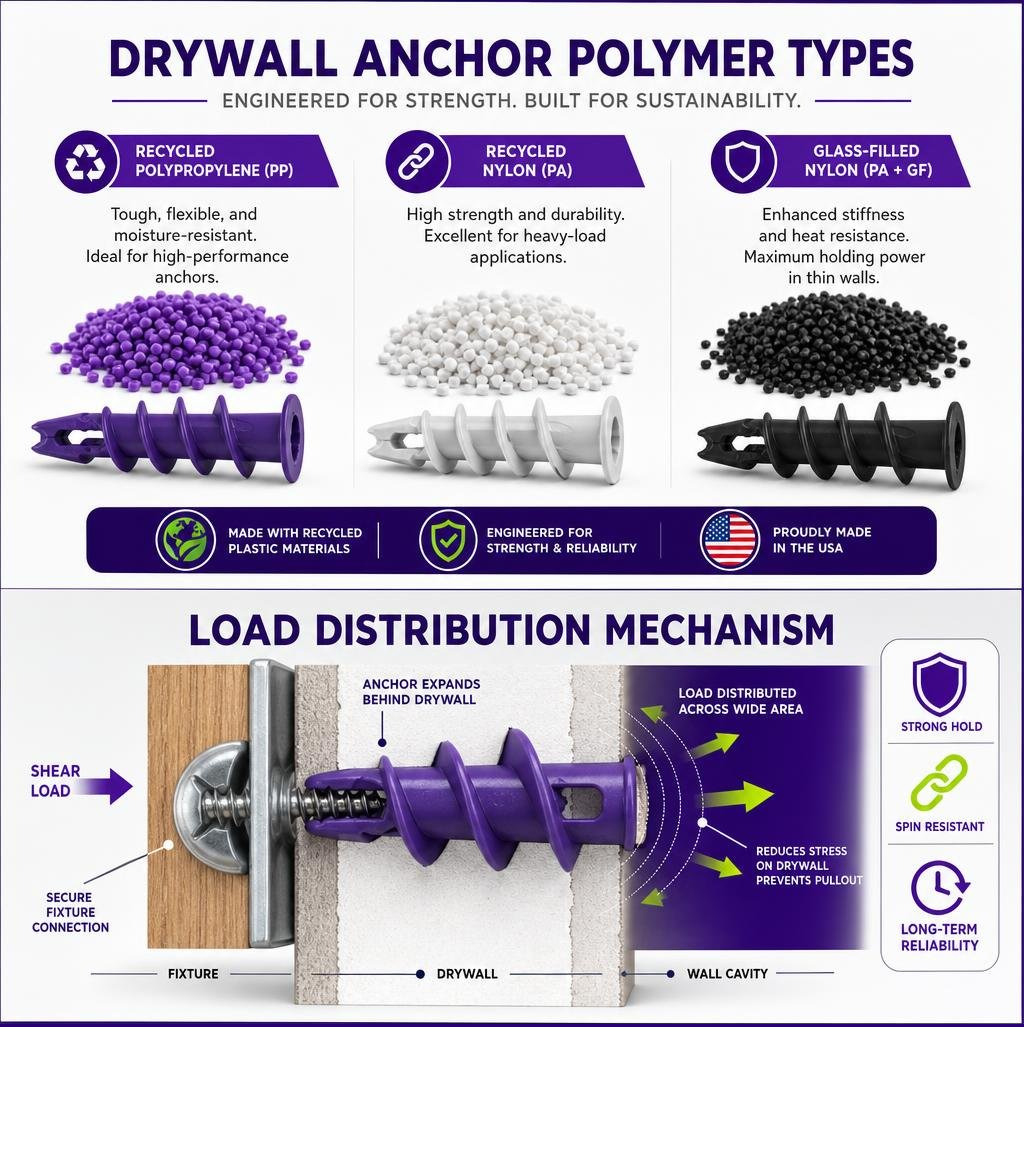
Eco-friendly drywall anchors do not sacrifice structural capability for sustainability. High-grade recycled engineering resins match or exceed the mechanical properties of generic virgin plastics when properly formulated.
- Specially Formulated Inert Polypropylene: Polypropylene is a durable, recyclable thermoplastic. In anchor manufacturing, an inert, self-lubricating grade provides chemical resistance, clean threading, and flexibility. Polypropylene anchors do not corrode, will not react chemically with gypsum or metal screws, and resist moisture penetration.
- Glass-Filled Recycled Nylon: Adding microscopic glass fibers to recycled polyamide (nylon) creates high tensile strength and structural rigidity. Glass reinforcement prevents the fastener from twisting off or stripping under high installation torque, making it suitable for self-drilling designs.
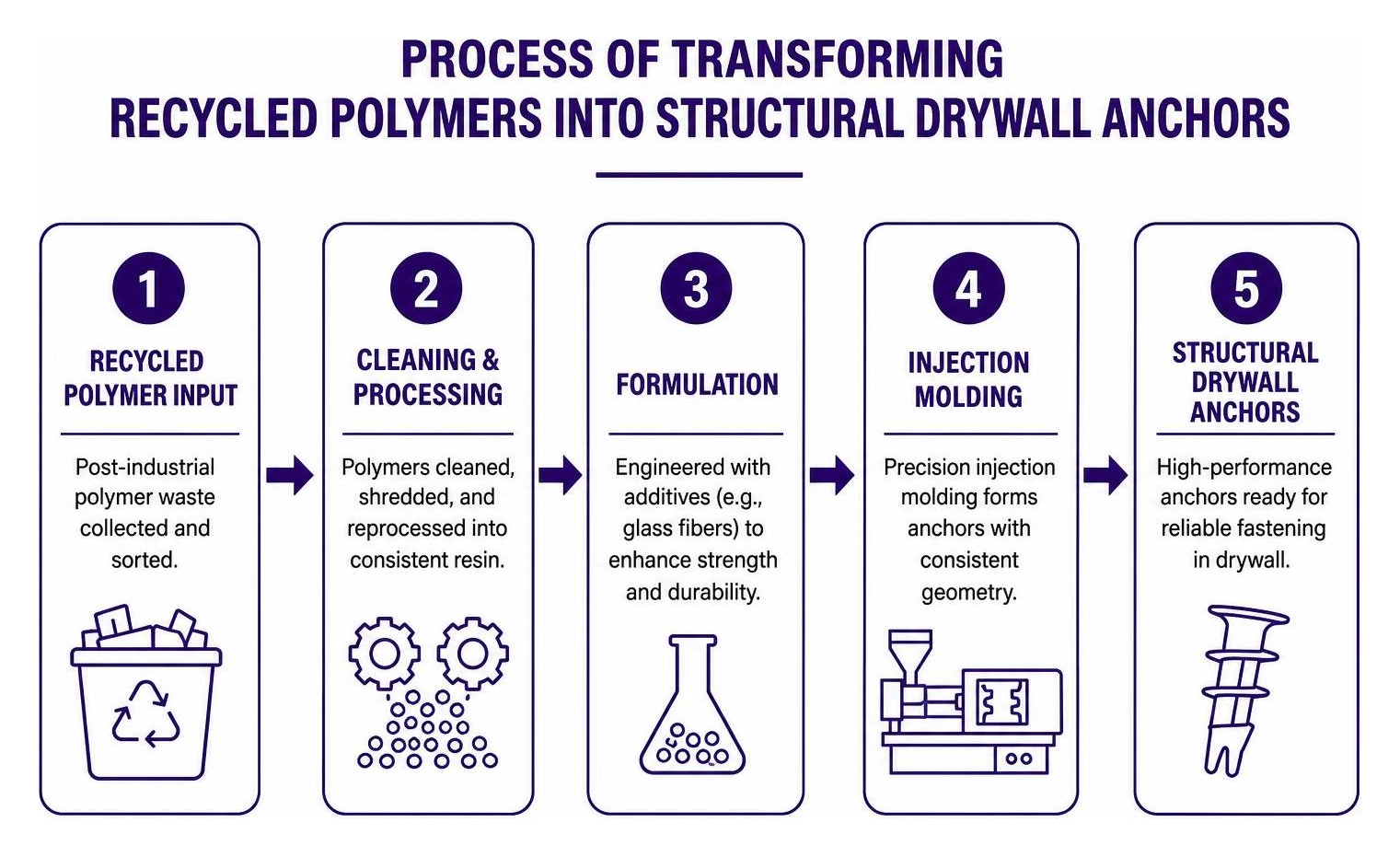
- Mechanical Parity: High-density recycled polymers offer the same compressive strength and shear resistance as virgin petroleum resins. Reclaimed polymers diverted from post-industrial waste streams maintain molecular integrity through precision injection molding.
- Corrosion Protection Synergy: Eco-friendly polymer bodies act as a dielectric barrier. When paired with zinc-coated or stainless steel screws, polymer anchors eliminate galvanic corrosion. Screws with quality zinc alloy coatings extend hardware lifespan by up to 50%, preserving the mounting point for decades.
Mechanical Plastics Corp & TOGGLER Product Lines
Mechanical Plastics Corp has manufactured fastening solutions since its founding in 1968, with headquarters in Norwalk, Connecticut. Their product catalog features domestic manufacturing across several specialized lines:
- TOGGLER ALLIGATOR Anchors: Molded in the USA from specially formulated, translucent, non-corrodible polypropylene. The ALLIGATOR features anti-rotation fins and an expandable solid-core design that functions in hollow sheetrock, concrete, and masonry backing.
- TOGGLER SnapSkru SP: Manufactured in the USA from glass-filled nylon. This self-drilling anchor cuts directly into sheetrock without pre-drilling and provides an audible click when its expanding jaws activate behind the board.
- Hollow-Wall Toggle Fasteners: Traditional residential toggle fasteners utilize polypropylene bodies to secure lightweight to medium-duty items across 3/8-inch to 1/2-inch drywall panels.
GHOSTUD High-Capacity Drywall Anchors
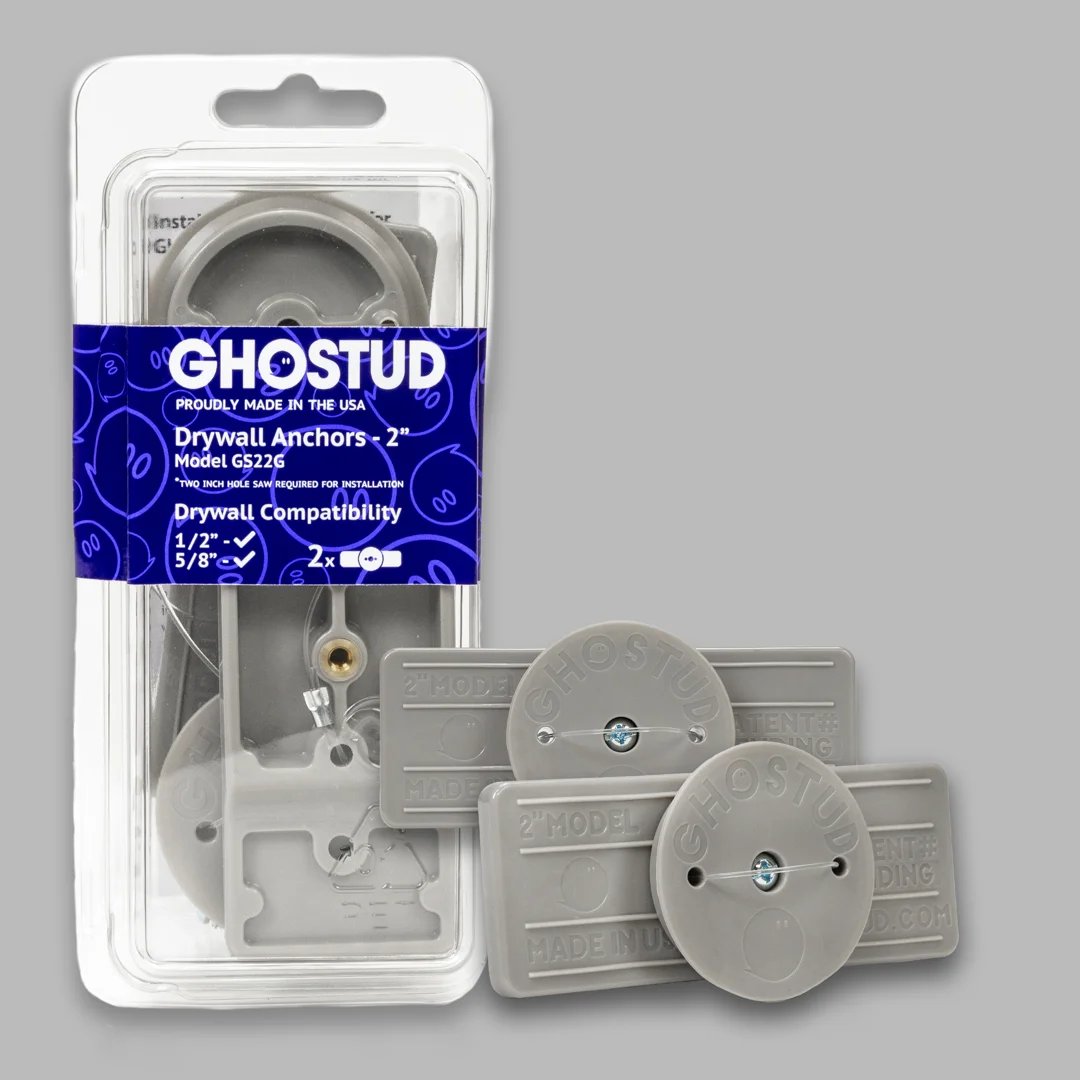
At GHOSTUD, our domestic production utilizes 100% recycled plastic to solve the problem of hanging heavy items on hollow walls without backing studs.
Standard expansion plugs concentrate stress onto fragile gypsum cores, leading to wall blowout when load thresholds are crossed. We designed our hardware around a patented load-distribution plate that spreads downward and outward force across a wide surface area behind the drywall sheet. By diverting industrial plastic waste into durable, structural mounting plates made in the USA, we provide a domestic solution for heavy-duty studless installations. You can explore the engineering behind our products to see how geometric load distribution replaces traditional friction-based anchoring.
How Do USA-Made Eco-Friendly Anchors Compare Across Different Load Capacities?
Understanding how drywall anchors perform requires distinguishing between the two primary mechanical forces acting on a wall fastener: shear load and tensile pull-out load.
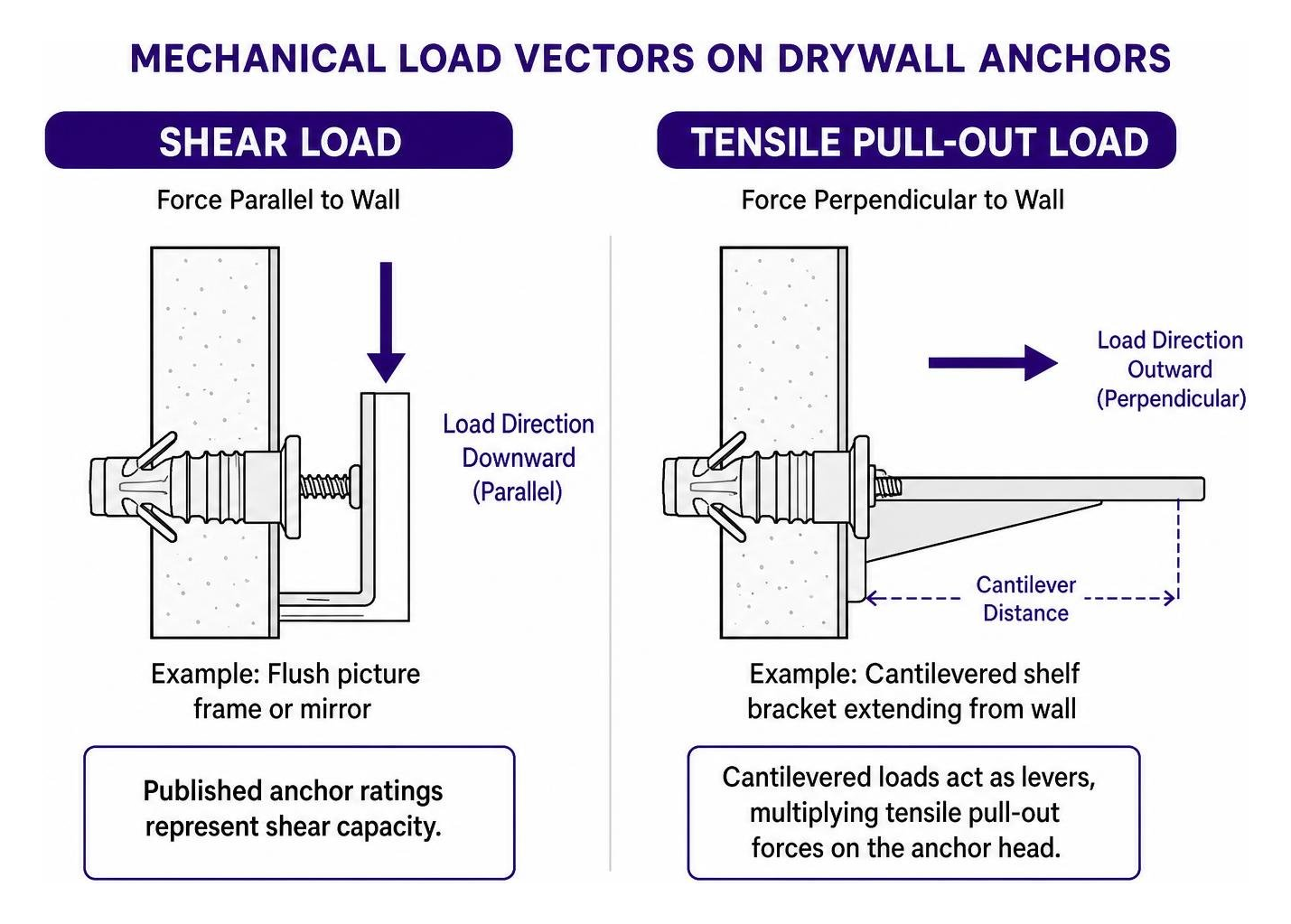
- Shear Load: Downward force applied parallel to the wall face (e.g., a flush picture frame or mirror). Published anchor ratings represent shear capacity unless explicitly labeled otherwise.
- Tensile Pull-Out Load: Outward force pulling perpendicular to the wall face (e.g., a cantilevered shelf bracket extending 10 inches from the wall). Cantilevered loads act as levers, multiplying tensile pull-out forces on the anchor head.
Anchor Categories and Holding Capacities
1. Light-Duty Recycled Plastic Expansion Plugs
Traditional plastic sleeve plugs require a pre-drilled hole. As the screw enters, it forces the plastic outward against the gypsum. Traditional plastic expansion anchors typically support 10 to 25 pounds in shear, depending on drywall thickness and plug quality.
Mechanical Failure Mode: Frictional slippage. The smooth plastic body pulls cleanly out of the crumbly gypsum core under light tension or cyclic vibration.
2. Medium-Duty Self-Drilling Threaded Anchors
Anchors like the glass-filled nylon TOGGLER SnapSkru SP cut their own threads directly into the gypsum board. In 1/2-inch drywall with a #8 x 1-1/2-inch screw, the SnapSkru SP achieves an ultimate tensile strength of 79 pounds and a shear strength of 149 pounds.
Mechanical Failure Mode: Gypsum thread stripping. Over-tightening the anchor shears the soft plaster core into fine dust, leaving the wide threads with zero mechanical purchase.
3. Heavy-Duty Load-Distribution Drywall Anchors
When mounting substantial fixtures without accessible studs, mechanical toggle bolts or load-distribution plates are required. Toggle bolts support weights exceeding 100 pounds by spreading tension across a metal wing behind the wall.
For high-capacity requirements, our GS1 anchor installs with a 1-inch hole saw and is rated up to 250 pounds in 1/2-inch or 5/8-inch drywall. For maximum residential and commercial demands, our GS2 anchor installs with a 2-inch hole saw and is rated up to 1,000 pounds shear in 1/2-inch or 5/8-inch drywall. Both are manufactured from 100% recycled plastic in the USA and are available in 2-packs and 20-packs.
Anchor Load Comparison
| Anchor Type | Primary Material | Drywall Thickness | Verified Shear Rating | Primary Mechanical Application |
|---|---|---|---|---|
| Standard Plastic Plug | Recycled Polypropylene | 3/8″ to 1/2″ | 10 – 25 lb | Small frames, light smoke detectors |
| TOGGLER SnapSkru SP | Glass-Filled Nylon | 1/2″ | 149 lb shear (79 lb tensile) | Clocks, medium artwork, curtain rods |
| TOGGLER ALLIGATOR AF8 | Inert Polypropylene | 1/2″ | 171 lb shear | Electrical boxes, shelving brackets |
| GHOSTUD GS1 | 100% Recycled Plastic | 1/2″ or 5/8″ | Up to 250 lb | Floating shelves, heavy mirrors |
| GHOSTUD GS2 | 100% Recycled Plastic | 1/2″ or 5/8″ | Up to 1,000 lb shear | Heavy commercial displays, cabinetry |
Critical Safety and Structural Limitations
Drywall anchors are strictly engineered for hollow sheetrock where wall framing is unavailable. Always observe these strict boundaries:
- Never substitute for a stud: Drywall anchors are designed for studless sheetrock. If a solid wood or metal framing stud is positioned where you want to mount your fixture, drive structural wood screws directly into the stud.
- Prohibited Human-Weight Applications: Drywall anchors must never be used for grab bars, handrails, safety rails, ADA applications, aging-in-place installations, fall prevention, or any fixture intended to support human body weight.
- No Anti-Tip Child Safety Use: Never rely on drywall anchors for anti-tip furniture straps or child-safety anchoring systems.
- Drywall Only: GHOSTUD anchors are designed strictly for 1/2-inch and 5/8-inch drywall assemblies. Do not install them in plaster and lath, masonry, concrete, brick, tile backer board, or structural steel studs.
When GHOSTUD Is the Wrong Choice: If you scan your wall with an electronic stud finder and locate a wood 2×4 stud directly behind your layout mark, do not cut a 1-inch or 2-inch hole for a hollow-wall anchor. Put down the hole saw, pre-drill an 1/8-inch pilot hole into the center of the wooden stud, and secure your bracket with a #10 or #12 structural wood screw driven at least 1.5 inches into the solid lumber.
How Can You Verify Recycled Content and Domestic Manufacturing Claims?
Marketing claims on hardware packaging can be misleading. Terms like “green,” “eco-designed,” or “engineered in the USA” do not always mean the product is manufactured domestically from recycled resins.
1. FTC “Made in USA” Standards
The Federal Trade Commission (FTC) requires that products bearing an unqualified “Made in USA” label must be “all or virtually all” made in the United States. This means all significant parts, processing, and labor must originate domestically. Look for explicit “Made in USA” text directly stamped onto the anchor body or printed on the retail carton, rather than vague phrasing like “Packaged in the USA.”
2. Post-Consumer vs. Post-Industrial Recycled Content
Manufacturers using genuine recycled feedstocks clearly state their material sources:
- Post-Industrial Recycled (PIR): Scrap polymer collected from manufacturing processes and re-pelletized before reaching consumers. It provides consistent quality and chemical purity.
- Post-Consumer Recycled (PCR): Plastics collected from municipal recycling programs (such as milk jugs or detergent bottles). PCR requires rigorous sorting and processing to achieve structural grade.
3. Review Technical Data Sheets (TDS)
Request the manufacturer’s Technical Data Sheet or Safety Data Sheet (SDS). Reliable domestic producers disclose polymer classifications (e.g., PA66-GF for glass-filled nylon, or PP for polypropylene) along with ASTM testing standards for tensile pull-out and shear strength.
4. Pricing Realities
Recycled US-made fasteners involve domestic labor and high-grade compound sorting. While generic imported plastic plugs cost pennies per unit (and fail regularly under modest loads), precision-engineered recycled anchors cost slightly more per unit. This minor upfront difference prevents wall failure and costly drywall patching.
Frequently Asked Questions About Eco-Friendly Drywall Anchors
Can recycled plastic drywall anchors handle heavy-duty loads?
Yes. Recycled polymers reinforced with glass fibers or molded into load-distributing geometries handle high shear forces in 1/2-inch and 5/8-inch drywall. Because heavy-duty capacity depends on spreading stress across the drywall face rather than relying on plastic friction alone, engineered recycled polymers match the structural capabilities of virgin resins.
Are eco-friendly plastic drywall anchors removable or reusable?
It depends on the anchor design. Threaded self-drilling anchors can be unscrewed from the wall, though backing them out leaves a damaged hole in the sheetrock that cannot be reused for the same size anchor. Heavy-duty load-distribution anchors require cutting 1-inch or 2-inch holes and are designed as permanent structural mounting points. They are not temporary, damage-free, or renter-friendly solutions.
Where can you buy certified USA-made recycled drywall anchors?
USA-made sustainable drywall fasteners can be purchased directly through manufacturer websites, specialty fastener suppliers, and commercial building supply distributors. You can review technical documentation and order domestic load-distribution fasteners through our verified online catalog.
What Is the Best Drywall Anchor Choice for Your Next Sustainable Project?
Selecting the right drywall anchor requires matching fixture weight, drywall thickness, and mechanical force profiles to the correct hardware.
- Assess the Load: Determine if the item applies direct downward shear (like a mirror) or cantilevered tensile pull-out (like a deep shelf).
- Check for Studs: Always use an electronic stud finder first. If a framing stud is accessible, fasten directly into the wood with structural screws.
- Select Sustainable Hardware: For light picture hanging, opt for domestic polypropylene plugs. For medium tasks, use self-drilling glass-filled nylon anchors. For heavy loads on studless hollow drywall, install a high-capacity recycled load-distribution anchor.
Using high-performance, USA-made recycled plastic drywall hardware prevents wall damage, keeps plastic waste out of landfills, and ensures a solid, durable mount.