
How to Securely Mount a Heavy Mirror in 7 Simple Steps
Secure a Heavy Mirror With the Right Load Path
To anchor a heavy mirror safely, weigh the mirror, identify the wall material, and use mechanical hardware rated well above the mirror’s weight. Fasten into wood studs whenever they line up with your placement. If they do not, use a mounting system designed for intact drywall and spread the load across two or more points. For wide or very heavy mirrors, a properly installed French cleat is often the strongest choice because it distributes downward shear load over a broad area.
Avoid plastic picture-frame anchors, adhesive strips, and a single center hook. A mirror also pulls outward when bumped, so the frame hardware, wall fasteners, and wall surface all need to be sound – not just rated for vertical weight.
These seven steps will help you measure, level, choose the right hardware, and mount the mirror without turning a simple wall project into a broken-glass problem.
I’m Trevor Jones, and I have spent more than 16 years in entrepreneurship, marketing, and technology while developing high-capacity drywall mounting solutions. In this guide, I’ll break down how to anchor a heavy mirror to the wall by focusing on the practical forces, hardware choices, and installation checks that matter.
Assessing Mirror Weight, Wall Type, and Hardware Capacity
A successful installation starts by measuring the mirror’s physical mass and evaluating the wall substrate. Standard residential drywall is typically 1/2-inch or 5/8-inch thick gypsum board encased in paper facing. A 12×12-inch section of 1/2-inch drywall can support roughly 40 pounds of vertical shear load before the gypsum core deforms. Beyond this point, the underlying wall framing or specialized mechanical fasteners must bear the load.
A 24×60-inch wood-framed mirror weighs around 24 pounds, while an oversized 72×48-inch mirror can easily weigh 60 pounds or more. Knowing the exact weight determines whether standard methods suffice or if high-capacity structural fasteners are required. Reviewing professional resources like How to Hang Heavy Mirrors: Safe & Secure Installation confirms that mismatched hardware is one of the leading causes of installation failure.
| Mirror Weight Class | Measured Weight | Recommended Substrate Strategy | Recommended Fastener Hardware |
|---|---|---|---|
| Light | Under 20 lbs | Hollow Drywall or Studs | Zinc self-drilling anchors, picture hooks, or wood screws |
| Medium | 20 to 50 lbs | Drywall (Anchored) or 1 Wood Stud | GS1 GHOSTUD, toggle bolts, or 2-inch wood screws |
| Heavy | 50 to 100 lbs | Minimum 1–2 Wood Studs or High-Capacity Drywall Anchors | GS2 GHOSTUD, structural cabinet screws, or French cleat |
| Extra Heavy | 100+ lbs | Direct Wood Studs or Masonry Anchors | Lag bolts into studs, masonry expansion bolts, or full-length cleat |
Identifying Wall Substrates and Stud Locations
Before drilling, identify whether the wall is drywall, plaster, or masonry. Standard modern construction features vertical wood studs spaced 16 inches or 24 inches on center behind drywall sheets. A simple push-pin test can confirm your surface material: a steel pin pushes cleanly into standard drywall with moderate hand pressure, whereas it will bend against solid plaster or masonry.
Use a magnetic or electronic stud finder to locate the edges and center of the framing studs. If working with solid brick or concrete block, standard hollow-wall fasteners will not work; the installation requires a hammer drill, carbide-tipped masonry drill bits, and masonry expansion screws rated for 200+ lbs.
Calculating the 2x Working Load Safety Margin
Every hanging system experiences two distinct mechanical forces:
- Vertical Shear Load: The downward gravitational pull against the wall surface.
- Pull-Out Tension: The outward force pulling the fastener straight out of the wall, created when the mirror hangs away from the surface or gets bumped.
Always apply the 2x safety rule: select mounting hardware rated for at least twice the measured weight of the mirror. If a mirror weighs 45 pounds, select a hardware combination rated for at least 90 pounds. This buffer absorbs dynamic shocks from opening doors, footsteps, cleaning, and wall vibrations over time.
Comparing Mounting Systems: French Cleats, Anchors, and D-Rings
Selecting the correct mounting hardware determines the long-term stability of the mirror.

French Cleat Interlocking Systems
A French cleat uses two interlocking 45-degree beveled aluminum or wood rails. One bracket mounts horizontally to the back of the mirror frame facing down, while the matching bracket secures to the wall facing up.
When the mirror is lowered into place, gravity locks the two bevels together, distributing the downward shear force evenly across the entire length of the wall bracket rather than focusing stress onto isolated fastener points. An 18-inch commercial aluminum French cleat is rated for up to 200 pounds, while a 30-inch model can support up to 300 pounds when anchored across two framing studs.
Heavy-Duty Drywall Anchors
When wall studs do not align with your intended design placement, specialized hollow-wall anchors transfer the load across the drywall substrate. Standard plastic expansion plugs should never be used for heavy items because their smooth outer casing easily pulls through crumbling gypsum under tension.
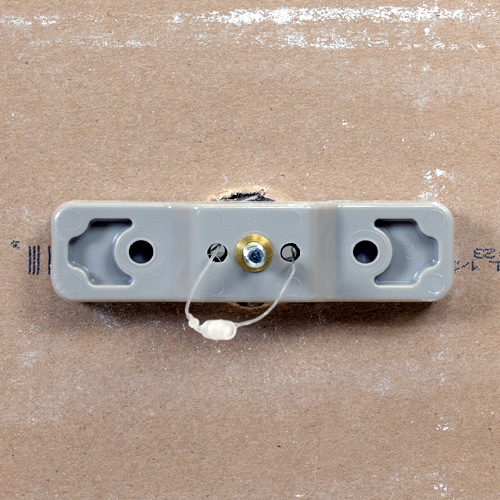
For hollow drywall installations where no wood stud is present, the GS1 GhostUD Drywall Anchor provides up to 250 lb of load capacity in 1/2-inch or 5/8-inch drywall, utilizing an internal load-spreading design manufactured from 100% recycled plastic in the USA. For extreme loads, the GS2 anchor provides up to 1,000 lb shear in 1/2-inch or 5/8-inch drywall using a 2-inch hole saw cutout. These ratings apply strictly to vertical shear loads on sound drywall, not as an unqualified pull-out figure for cantilevered projections.
Standard 1/8-inch spring toggle bolts provide approximately 45 to 100 pounds of holding capacity in sound 1/2-inch drywall by spreading spring-loaded metal wings against the rear paper backing. Zinc self-drilling anchors generally hold 30 to 50 pounds, while steel molly bolts support up to 50 pounds through collapsing metal sleeves.
D-Rings vs. Hanging Wire Limitations
Factory-installed steel D-rings screwed into the side rails of the mirror frame provide secure, direct hanging points when hung straight onto two matched wall hooks.
Conversely, stringing braided picture wire across the D-rings introduces severe failure modes for mirrors over 20 pounds:
- Wire Sag: The wire stretches under sustained tension, sagging 3.5 to 5 inches below the top rail and exposing hardware.
- Inward Frame Bending: The angled wire exerts inward lateral compression on the frame joints, which can split mitered corners.
- Fastener Lever Effect: Protruding screws supporting wire act as mechanical levers, bending downward and crushing the drywall collar beneath the screw shaft.
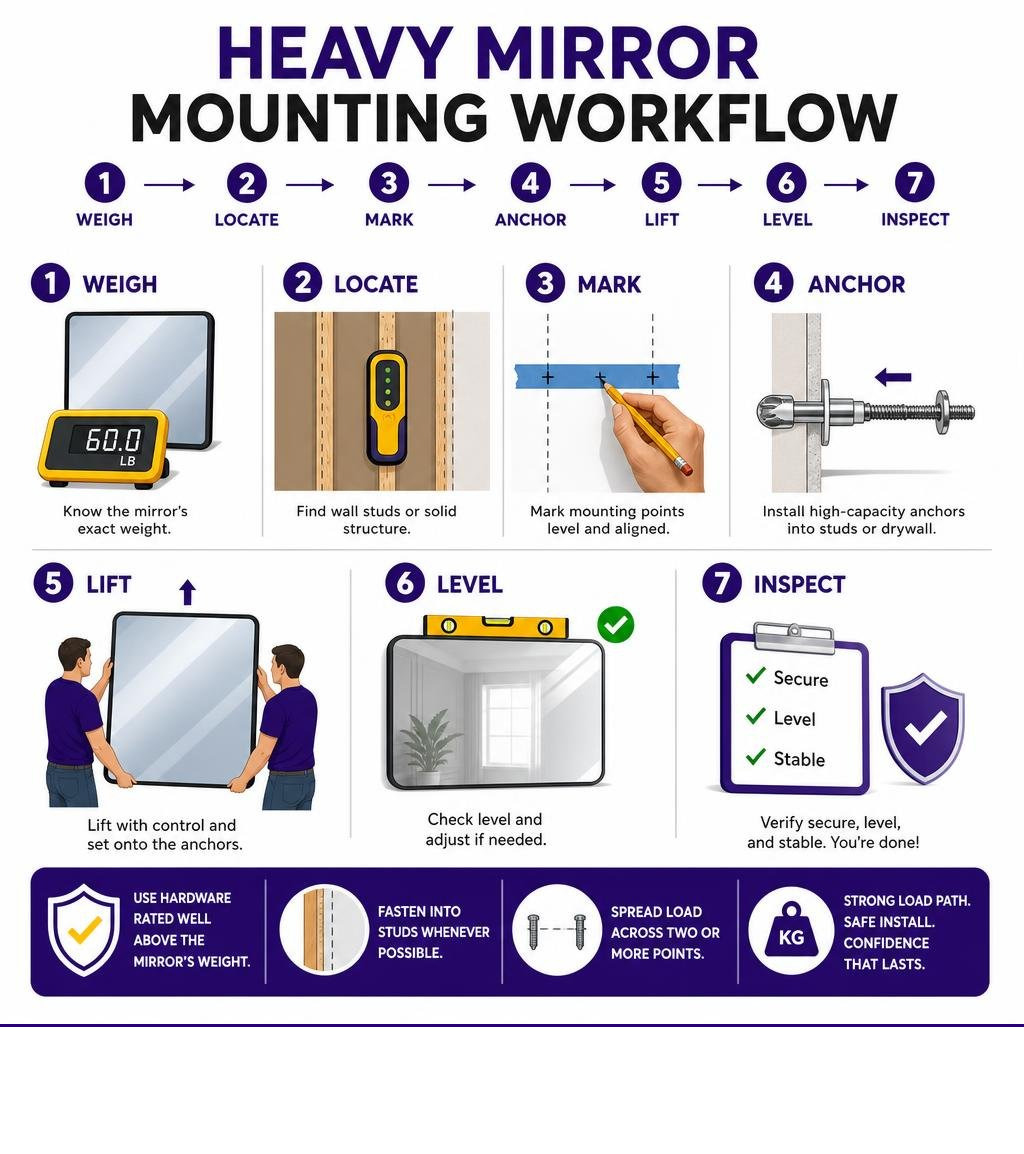
How to Anchor a Heavy Mirror to the Wall in 7 Steps

Follow these seven procedural steps to anchor your mirror securely.
Step 1: Weigh and Inspect the Mirror Frame
- Step onto a digital scale holding the mirror, then subtract your own body weight to find the exact net mass.
- Lay the mirror face down on a soft moving blanket.
- Inspect the wooden or metal frame joints for gaps, cracking, or glue separation.
- Tighten any loose factory D-rings or bracket screws using a manual screwdriver.
Step 2: Determine Eye-Level Placement and Tape the Outline
- Measure 57 to 60 inches up from the floor to establish the standard gallery-level centerline for the mirror’s visual center.
- If mounting above a console table or sofa, leave 8 to 12 inches of clearance between the furniture top and the frame’s bottom edge.
- Outline the outer perimeter of the mirror using blue painter’s tape on the wall to check clearances, sightlines, and room reflections.
Step 3: Map Studs and Mark Hardware Anchor Points
- Sweep the wall inside your taped perimeter with an electronic stud finder. Mark all stud edges with a pencil.
- Measure the vertical distance from the top of the mirror frame down to the connection point of the D-rings or French cleat.
- Transfer these measurements inside the tape outline on the wall.
- Connect the mounting marks using a 4-foot bubble level or laser level to ensure a level horizontal plane.
Step 4: How to Anchor a Heavy Mirror to the Wall Using Studs
When wood studs align with your anchor points:
- Drill a pilot hole into the center of the stud using a 1/8-inch wood drill bit to prevent splitting the lumber.
- Drive 2.5-inch or 3-inch #8 or #10 structural cabinet screws directly through your mounting bracket or cleat into the stud.
- Ensure the screw penetrates at least 1.5 to 2 inches directly into solid wood framing. Avoid using standard drywall screws, which are hardened for gypsum grip but brittle under high shear stress.
Step 5: How to Anchor a Heavy Mirror to the Wall Without Studs
When studs are unavailable in your mounting zone, use verified mechanical drywall anchors suited for hollow sheetrock:
- Mark the exact drill point on your level line.
- If installing high-capacity drywall anchors, cut the precise hole specified by the manufacturer (e.g., a 1-inch hole saw for GS1 anchors).
- Insert the anchor body flush against the drywall face, following the manufacturer’s orientation guides.
- If using standard spring-toggle bolts, drill the required clearance hole (typically 3/8-inch to 1/2-inch), pass the machine bolt through your D-ring hook or French cleat bracket, thread the spring wing onto the bolt tip, push the wing through the drywall, and tighten the bolt with a manual screwdriver until snug against the rear surface.
Step 6: Coordinate a Two-Person Lift and Mount the Mirror
- Plan the lift path and clear all obstacles, tools, and cords from the floor.
- With two people, grip the mirror firmly by the structural side rails of the frame. Do not lift by the top rail, decorative trim, or glass edge.
- Carefully lift the mirror to the wall and guide the frame hardware onto the wall hooks or lower the mirror-side French cleat onto the wall rail until they fully interlock.
- Verify horizontal alignment by resting a bubble level across the top frame rail.
Step 7: Perform a Load-Tug Test and Stabilize the Base
- Apply steady downward and slight outward hand pressure (approximately 10 to 15 pounds of force) to the lower frame rails for 10 to 15 seconds to verify that the wall anchors do not pull out or shift.
- Check the drywall around the mounting points for cracking, crushing, or loose dust.
- Adhere self-adhesive rubber bumpers or high-density foam pads to the bottom two rear corners of the frame. This stops the mirror from wobbling against uneven drywall and keeps the frame parallel to the wall.
Essential Safety Precautions and Critical Mistakes to Avoid
Mounting heavy glass over finished living spaces requires understanding critical environmental and mechanical failure points.
Securing Heavy Mirrors Above Beds and High-Traffic Areas
Mirrors hung in bedrooms, hallways, or above couches are subject to constant room vibrations and physical contact.
- Never rely on friction-fit picture nails or standard hanging wire above seating or sleeping zones.
- Use direct, mechanical interlocking French cleats or closed-loop D-rings screwed into wall studs whenever possible.
- Maintain at least 8 to 12 inches of clearance above furniture to prevent head bumps.
How to Anchor a Heavy Leaning Floor Mirror
Full-length leaning floor mirrors create an open, airy visual aesthetic, but unanchored frames present a severe tip-over hazard in busy households:
- Install two anti-tip furniture safety straps into the upper third of the rear mirror frame.
- Fasten the opposite strap brackets into wood studs or heavy-duty hollow-wall anchors on the wall.
- Pull the nylon or steel cable straps taut so the mirror maintains its intentional leaning angle while remaining anchored against tipping forward.
- Place non-slip rubber grip pads beneath the mirror base on hard floors to prevent outward base sliding.
Common DIY Failures and When to Hire a Professional
- Thermal Degradation Above Fireplaces: Wall temperatures directly above an active fireplace can exceed 140°F (60°C). Repeated thermal cycling softens low-grade plastic wall plugs and degrades adhesive strips over time, leading to sudden fastener creep or pull-out under steady load. Always use all-metal fasteners above heat sources.
- Brittle Fasteners: Never use black phosphate drywall screws to hang structural brackets; they possess low shear ductility and snap under sudden lateral shocks.
- Damaged Substrates: If a drilled pilot hole crumbles or an anchor spins freely, remove the hardware immediately. Never re-insert an anchor into a damaged drywall hole.
- When to Call a Professional: If your mirror exceeds 75 to 100 pounds and no wood studs can be reached, or if you are mounting into historic plaster-and-lath walls where drilling causes severe crumbling, hiring a professional art installer or licensed contractor is the safest course of action.
Frequently Asked Questions
Can drywall hold a 50-pound mirror without studs?
Yes, provided you use heavy-duty hollow-wall anchors engineered for high-shear loads on sound 1/2-inch or 5/8-inch drywall. High-capacity anchors or dual spring-toggle bolts distribute the downward shear stress across a wide surface area of the gypsum core. Never hang a 50-pound mirror on drywall using standard plastic expansion plugs or small picture nails, which lack adequate pull-out and shear resistance.
What is the standard height to hang a heavy wall mirror?
The interior design standard is to position the center point of the mirror at average eye level, which is 57 to 60 inches from the finished floor. When hanging above a piece of furniture such as a sofa, mantel, or entryway console table, leave 8 to 12 inches of vertical clearance between the bottom of the mirror frame and the top of the furniture piece to maintain proper visual balance and prevent accidental contact.
Why should hanging wire be avoided on heavy mirrors?
Hanging wire concentrates the entire mass of the mirror onto a single apex point, pulling wall screws downward at an angle that increases mechanical leverage against hollow drywall. Over time, wire stretches, creeps, and can suddenly snap under cyclic fatigue. Furthermore, the tension across an angled wire pulls the mirror’s side frame rails inward, potentially separating the frame’s corner joinery.
Conclusion
Anchoring a heavy mirror securely comes down to understanding wall substrates, choosing fasteners rated with a 2x safety margin, and distributing vertical shear forces across multiple sound mounting points. Whenever framing aligns with your layout, driving structural screws directly into solid wood studs provides the strongest possible mount.
When studs are absent, choosing load-spreading mechanical anchors designed specifically for hollow drywall allows you to mount large pieces safely. Take the time to measure accurately, level your hardware with precision, and perform a physical load test before stepping back to enjoy your reflection.