
Mount a Shelf Without Studs Safely
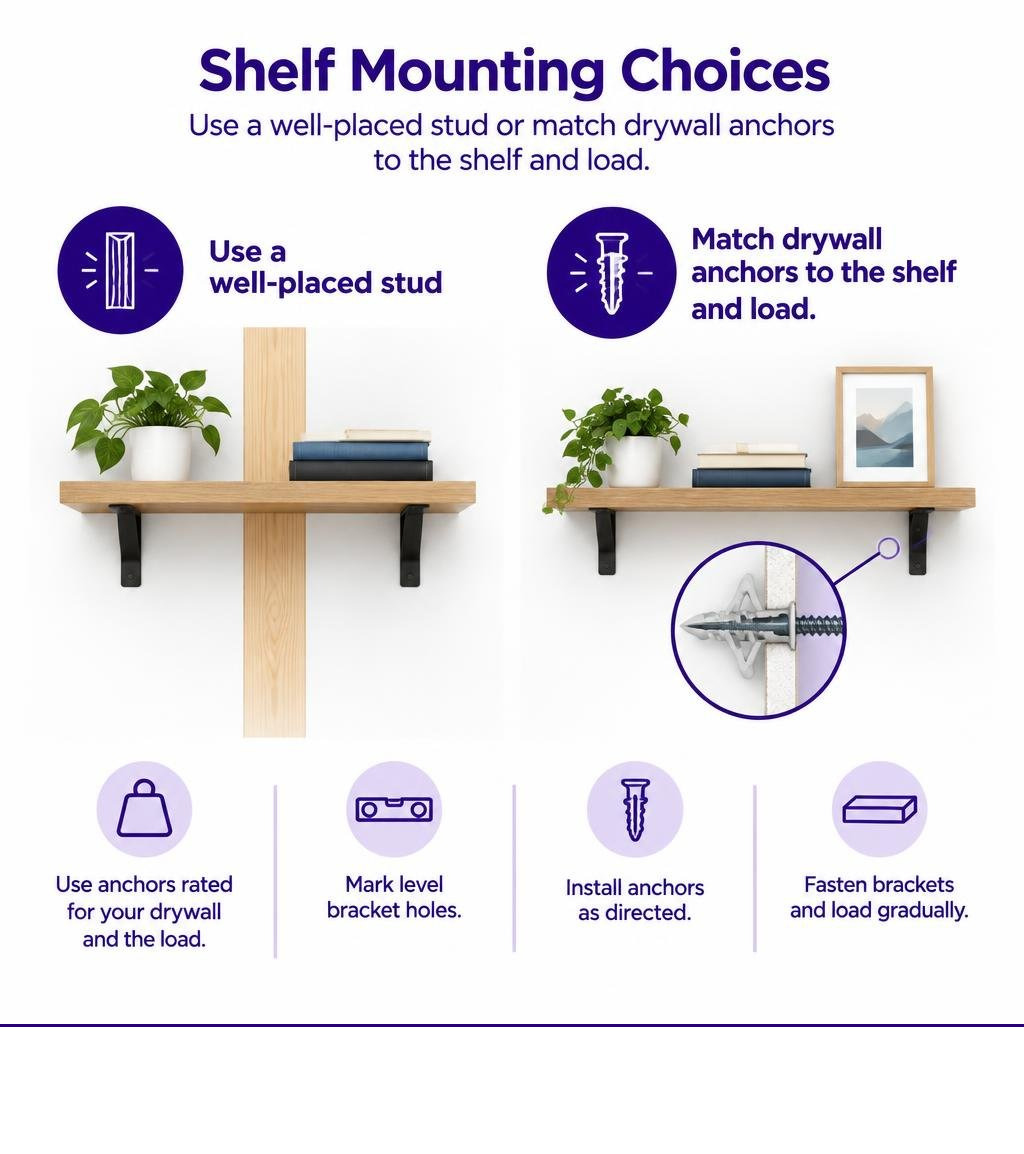
Use anchors rated for your drywall and the weight of the shelf plus everything you plan to put on it. Find and use a stud if one is properly placed. If not, mark level bracket holes, install the anchors as directed, fasten the brackets, and load the shelf gradually. A shelf pulls outward on its upper fasteners as well as downward, so a high shear rating alone does not tell you whether it will stay put.
For 1/2 in or 5/8 in drywall, load-distributed anchors can handle heavy shelving where no stud is available. For plaster, lath, concrete, masonry, brick, stucco, tile over backer board, or metal studs, choose a fastening method suited to that surface.
Understanding Wall Mechanics: Risks and Weight Limits Without Studs
Standard residential construction in North America places wood studs 16 inches apart on center behind gypsum wallboard. When your layout requires placing a shelf where no wood framing exists, the shelf relies entirely on the gypsum core and paper facings of the drywall panel. Drywall consists of a brittle, compressed gypsum core sandwiched between two layers of paper. It handles direct downward compression well, but it has low tensile and tear resistance.
Standard drywall anchors often fail due to paper shearing and core blowout. When an anchor carries more load than its contact area can support, it crushes the gypsum core. The anchor hole wallows out, the rear paper layer rips open, and the anchor pulls through the wall, causing a sudden blowout.

Understanding how to select the right drywall anchor for your load prevents these failures. Always locate and use a stud when one is accessible and properly positioned. When you must mount in hollow cavities, use anchors designed for 1/2-inch or 5/8-inch drywall only. They are not suitable for plaster, lath, concrete, masonry, brick, stucco, tile over backer board, or metal studs. Always select an alternative mechanical fastener engineered specifically for those substrates.
The Physics of Cantilevered Shelves and Pull-Out Risk
A mounted shelf is a lever that creates cantilever forces. When you place items on a shelf, the downward gravitational force translates into two distinct stresses:
- Downward Shear: The weight of the shelf and its payload trying to slide straight down the surface of the wall.
- Horizontal Pull-Out Tension: The rotational torque that leverages against the bottom of the shelf bracket and pulls outward on the top fasteners.
The deeper the shelf, the longer the lever arm and the higher the outward pull-out tension on the top fastener. For example, placing a 10-pound object on a 12-inch-deep shelf generates significantly more outward pull-out force at the top anchor than placing that same 10-pound object on a 4-inch-deep picture ledge. The top anchor bears almost all of this tensile pull-out load, while the lower anchor or bracket foot acts as a compression fulcrum pressing back into the wall.
Weight Capacity Calculation: How to Mount a Shelf Without Studs Safely
Never guess the weight of your installation. Calculate your total working load by combining two numbers:
- Tare Weight: The actual static weight of the shelf board, internal brackets, mounting plates, and mounting hardware.
- Payload Weight: The maximum combined weight of books, dishes, ceramics, or decor you will place on the shelf.
Add the tare weight and payload weight together, then apply a safety multiplier of 2. If your shelf weighs 8 pounds and will hold 22 pounds of books, your total expected load is 30 pounds. Sizing your system for a 60-pound total capacity ensures the anchors survive sudden impacts, like placing a heavy stack of books down quickly.
Review the strongest drywall anchor guide shear ratings explained to match your hardware to the drywall thickness. In modern builds, 1/2-inch drywall is standard for interior partitions, while 5/8-inch drywall is standard for ceilings and commercial fire-rated assemblies.
| Fastener Type | Target Drywall Thickness | Shear Rating per Anchor | Common Application Limits |
|---|---|---|---|
| Light-duty fastening option | 1/2 in or 5/8 in | 10 to 25 lb | Lightweight frames, key holders (<5 lb recommended) |
| Medium-duty fastening option | 1/2 in or 5/8 in | 20 to 50 lb | Small picture ledges, decorative clocks |
| Heavy-duty fastening option | 1/2 in or 5/8 in | 50 to 100+ lb | Medium wall shelves, wall clocks |
| GHOSTUD GS1 | 1/2 in or 5/8 in | Up to 250 lb | Curtain rods, towel bars, light shelving |
| GHOSTUD GS2 | 1/2 in or 5/8 in | Up to 1,000 lb shear | Heavy shelving, cabinets, mirrors, TVs |
Note: The 1,000 lb rating for the GS2 and 250 lb rating for the GS1 are static shear ratings measured in 1/2 in and 5/8 in drywall panels. Shear ratings represent vertical downward capacity, not pull-out force.
Step-by-Step Guide: How to Mount a Shelf Without Studs on Drywall
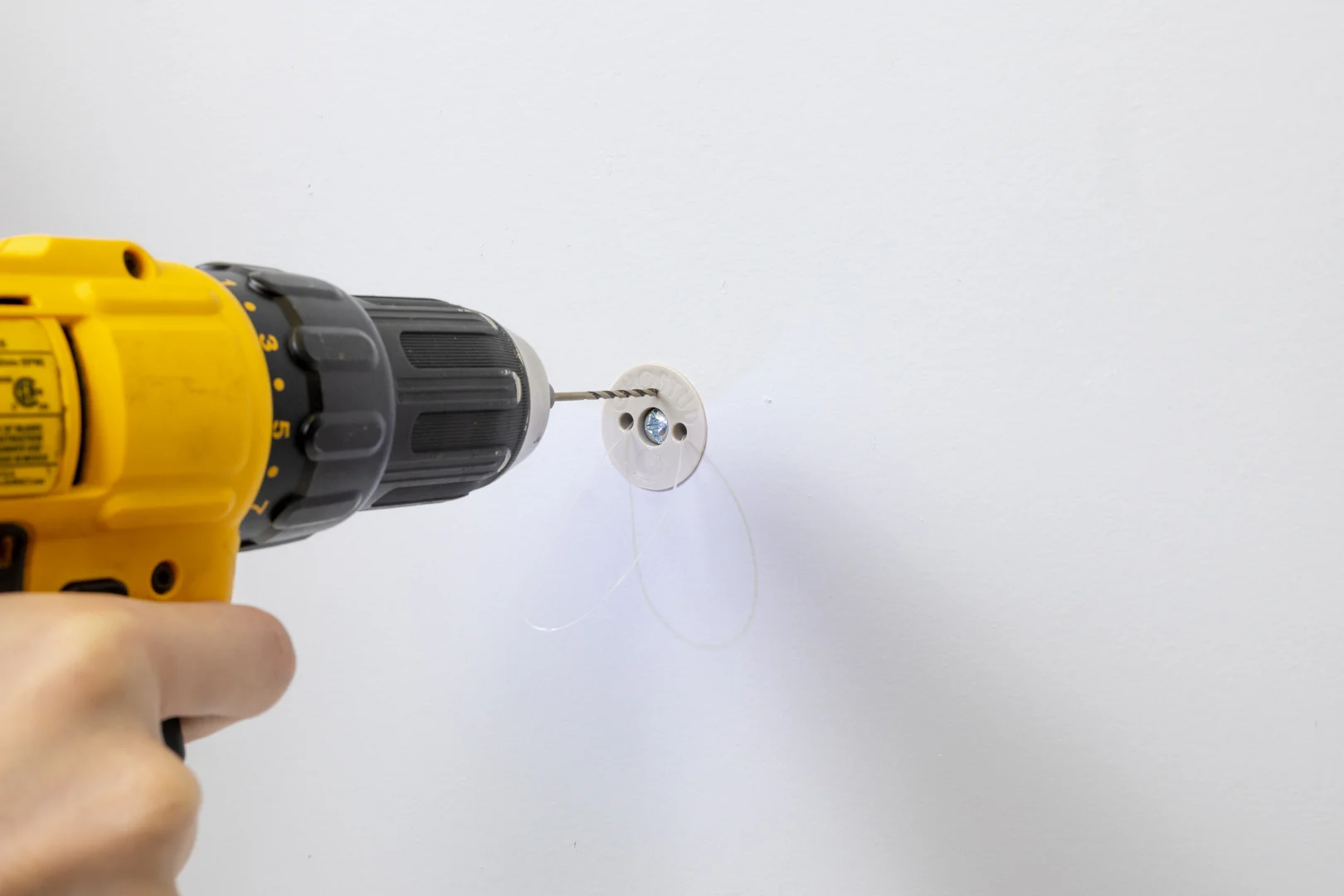
Mounting shelving without wood framing requires exact layout marking, proper drill bit selection, and disciplined torque control. Learn how to install floating shelves correctly in 5 steps by following these field instructions.
Step 1: Wall Inspection and Surface Preparation
- Run an electronic stud finder over the entire target zone. Confirm whether a stud is accessible within your layout zone. If a structural stud is available, drive screws directly into the framing instead of using drywall anchors.
- Scan for shallow electrical wiring and plumbing lines using an AC wire detector.
- Measure your drywall thickness at a nearby outlet box or baseboard edge to confirm whether your wall is 1/2-inch or 5/8-inch sheetrock.
- Wipe the wall surface clean with a lint-free cloth dampened with isopropyl alcohol to remove grease and dust from the bracket mounting zone.
Step 2: Marking and Leveling Anchor Locations
- Hold the shelf bracket or steel mounting backplate against the wall at your desired height.
- Place a torpedo level on top of the bracket body.
- Adjust the bracket until the level vial bubble centers between the indicator lines.
- Mark the exact center of each mounting hole using a sharp carpenter pencil.
- Double-check the distance between your marks against the corresponding slots on your shelf body to guarantee alignment before drilling.
Step 3: Drilling and Seating the Proper Anchors
For lightweight items under 5 pounds, choose hardware recommended by the shelf manufacturer. For heavier shelving in hollow drywall, use a fastening system designed for the shelf load and your confirmed drywall thickness.
For heavy static shelving loads on 1/2-inch or 5/8-inch drywall, the easiest way to fasten shelves to wall assemblies with high shear capacity is using load-distributed anchors.
- Attach the correct hole saw to your drill chuck (1-inch hole saw for GS1, 2-inch hole saw for GS2).
- Cut clean, perpendicular holes directly through the drywall at your pencil marks.
- Clear loose gypsum dust from the interior cavity edges.
- Insert the load-distributing anchor into the hole and seat it completely flush with the drywall surface.
Step 4: Securing Brackets and Load Testing
- Position the shelf bracket over the installed anchors.
- Drive the mounting screws through the bracket holes and into the anchor cores.
- Drive fasteners by hand using a manual screwdriver for the final two turns. Avoid over-torquing with high-speed impact drivers, which can strip fastener threads or crack the surrounding drywall face.
- Slide the shelf body over the mounting prongs or secure it to the brackets with the provided retaining screws.
- Apply gentle downward hand pressure to verify there is no bracket deflection or anchor slip.
- Load the shelf gradually, placing the heaviest items closest to the wall to minimize cantilever pull-out stress.
Choosing the Right GHOSTUD Anchor
When you need heavy-duty mechanical holding power in 1/2-inch or 5/8-inch drywall, GHOSTUD manufactured anchors provide load-distributed support across the drywall panel. Manufactured in the USA from 100% recycled plastic, they are available in 2-packs and 20-packs directly at ghostud.com.
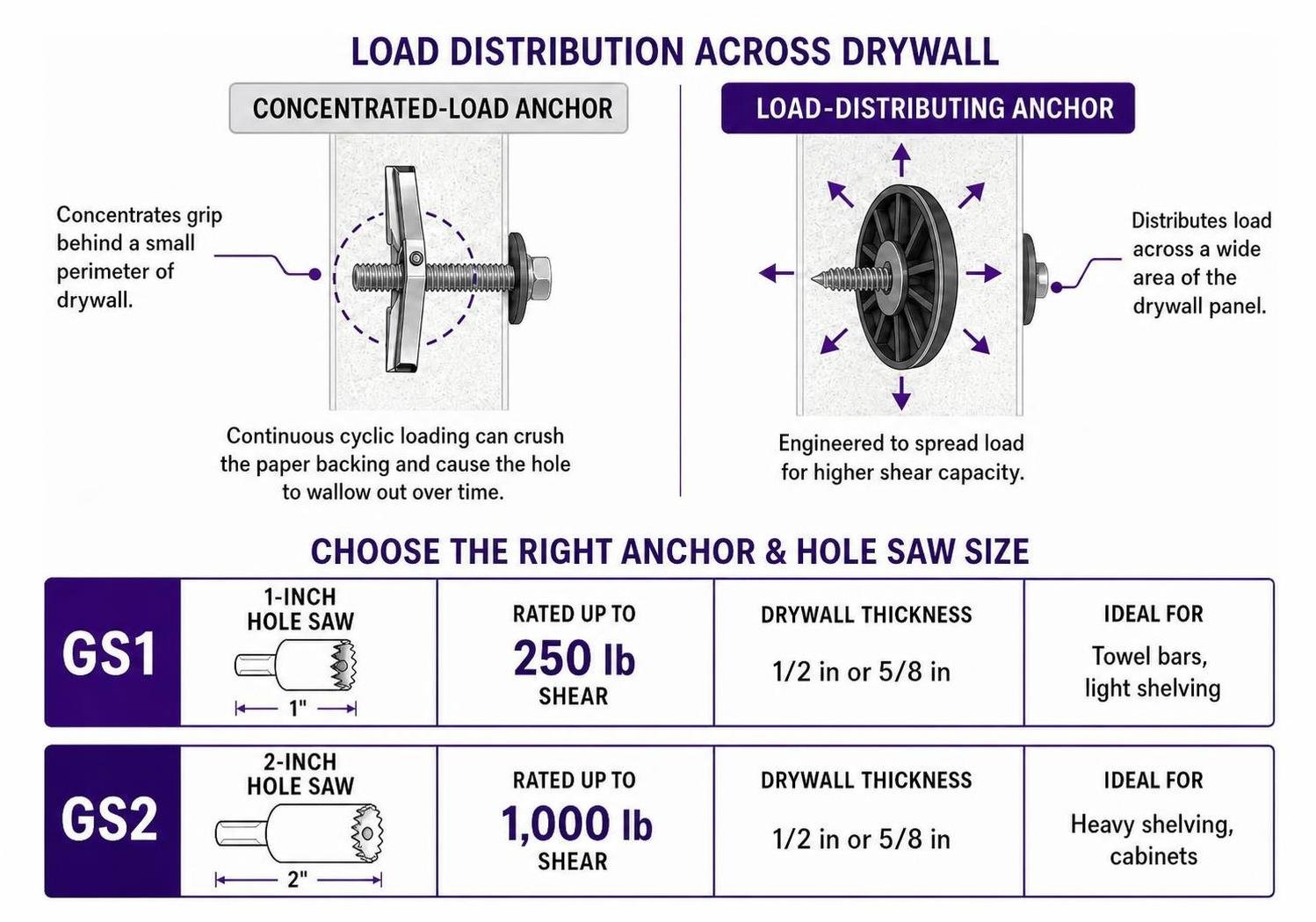
- GHOSTUD GS1: Uses a 1-inch hole size and is rated up to 250 lb shear in 1/2 in or 5/8 in drywall. It is engineered for dynamic, everyday fixtures such as curtain rods, towel bars, toilet paper holders, framed mirrors, and light shelving.
- GHOSTUD GS2: Uses a 2-inch hole size and is rated up to 1,000 lb shear in 1/2 in or 5/8 in drywall. It is engineered for heavy static loads such as heavy shelving units, large mirrors, upper storage cabinets, and wall-mounted televisions.
| Feature / Model | GHOSTUD GS1 | GHOSTUD GS2 |
|---|---|---|
| Drywall Thickness | 1/2 in or 5/8 in | 1/2 in or 5/8 in |
| Shear Rating | Up to 250 lb shear | Up to 1,000 lb shear |
| Required Hole Saw Size | 1 inch | 2 inch |
| Primary Applications | Towel bars, curtain rods, light shelves | Heavy shelving, cabinets, TVs, mirrors |
| Installation Permanence | Permanent drywall cutout | Permanent drywall cutout |
Unlike shallow anchors that pinch a tiny fraction of the wall, GHOSTUD distributes force over a wider internal surface. However, consider the trade-offs: GHOSTUD requires a dedicated hole saw, has a higher cost per unit than commodity plastic plugs, and creates a 1-inch or 2-inch hole in your sheetrock, making it a permanent installation.
Do not use GHOSTUD on plaster, lath, brick, masonry, concrete, or tile assemblies. Never use GHOSTUD for grab bars, safety rails, handrails, ADA installations, fall-prevention equipment, or any life-safety application where human body weight will be supported.
Advanced Mounting Considerations: Studs and Anchor Removal
Mastering shelf mounting means knowing how to address off-center studs and repair walls cleanly. Review how to secure a heavy shelf without pull-out failure for detailed load mechanics.
When to Use an Accessible Stud Near a Doorway
Doorways, entryways, and pass-throughs contain doubled 2×4 framing (king studs and jack studs) that provide solid anchoring. If you are mounting a shelf in a tight space between two doors and find an off-center stud, adjust your mounting strategy:
- Fasten one end of your shelf bracket directly into the wood stud with structural wood screws.
- Anchor the floating end of the bracket into the hollow drywall using a high-capacity drywall anchor rated for the remaining load share.
- Alternatively, install a 1×4 horizontal wood ledger board that spans across the nearest framing member. Fasten the ledger to the wood stud, paint it to match your trim or wall, and secure your shelf brackets anywhere along the face of that ledger board.
How to Remove Wall Anchors Without Damaging Drywall
When redecorating or moving, remove old anchors without tearing out large sections of drywall:
- Existing anchor type 1: Back the center screw out completely. Insert a standard #2 Phillips screwdriver into the anchor body, apply light pressure, and turn counterclockwise until the anchor threads back out of the drywall.
- Existing anchor type 2: Thread a screw two turns into the plastic sleeve. Grip the screw head with pliers and pull the anchor straight out. If the collar resists, score around the outer rim with a utility knife to slice the head off, then push the remaining sleeve into the wall cavity.
- Existing anchor type 3: Loosen and remove the center machine screw. The spring wings behind the wall will drop harmlessly down inside the hollow wall cavity.
- Finishing the Repair: Clean away loose paper burrs around the hole. Press a dab of lightweight spackle into the void, feather the edges with a putty knife, let it dry for 2 hours, sand it flush with 220-grit sandpaper, and apply matching touch-up paint.
Frequently Asked Questions About Studless Shelf Mounting
Can a GHOSTUD anchor support a floating bookshelf?
Yes, provided you choose the appropriate GHOSTUD model and stay within its shear rating for your drywall thickness (up to 250 lb shear for GS1 or up to 1,000 lb shear for GS2 in 1/2 in or 5/8 in drywall). Full rows of hardcover books create heavy loads and strong cantilever pull-out leverage. Calculate the total combined weight of your shelf and books, ensure your shelf bracket design supports the cantilever force, and load heavy books closest to the wall face.
Why does installing a GHOSTUD anchor require drilling?
GHOSTUD anchors use a load-distributing design that transfers stress across a broad section of the drywall core rather than concentrating it at a single point. To seat this mechanism inside 1/2-inch or 5/8-inch drywall, you must cut a clean circular opening using a 1-inch hole saw for the GS1 or a 2-inch hole saw for the GS2.
What is the difference between shear capacity and pull-out force?
Shear capacity measures a fastener’s resistance to downward vertical sliding forces acting parallel to the wall face. Pull-out force measures the fastener’s resistance to tension pulling straight out perpendicular to the wall. Shelves subject fasteners to both forces simultaneously: downward shear from total weight and horizontal pull-out at the upper bracket screws caused by rotational cantilever torque.
Conclusion
Mounting a shelf without studs requires matching your hardware to the actual working load and wall structure. Always locate and anchor into a wood stud whenever one is available at your target position. For hollow 1/2-inch and 5/8-inch drywall assemblies, use a high-capacity, load-distributing fastening system when the shelf load calls for it.
Calculate your total tare and payload weight, use a safety factor of 2, and ensure your anchors are fully seated before loading your shelves. For in-depth framing comparisons, installation walkthroughs, and load specs, explore our complete floating shelves guide.
Take your tape measure to the wall, mark your stud locations, and select the right anchor for your shelf’s total load.