
Step-by-Step Guide to Drywall Anchor Types
Choose the Right Drywall Anchor Before You Drill
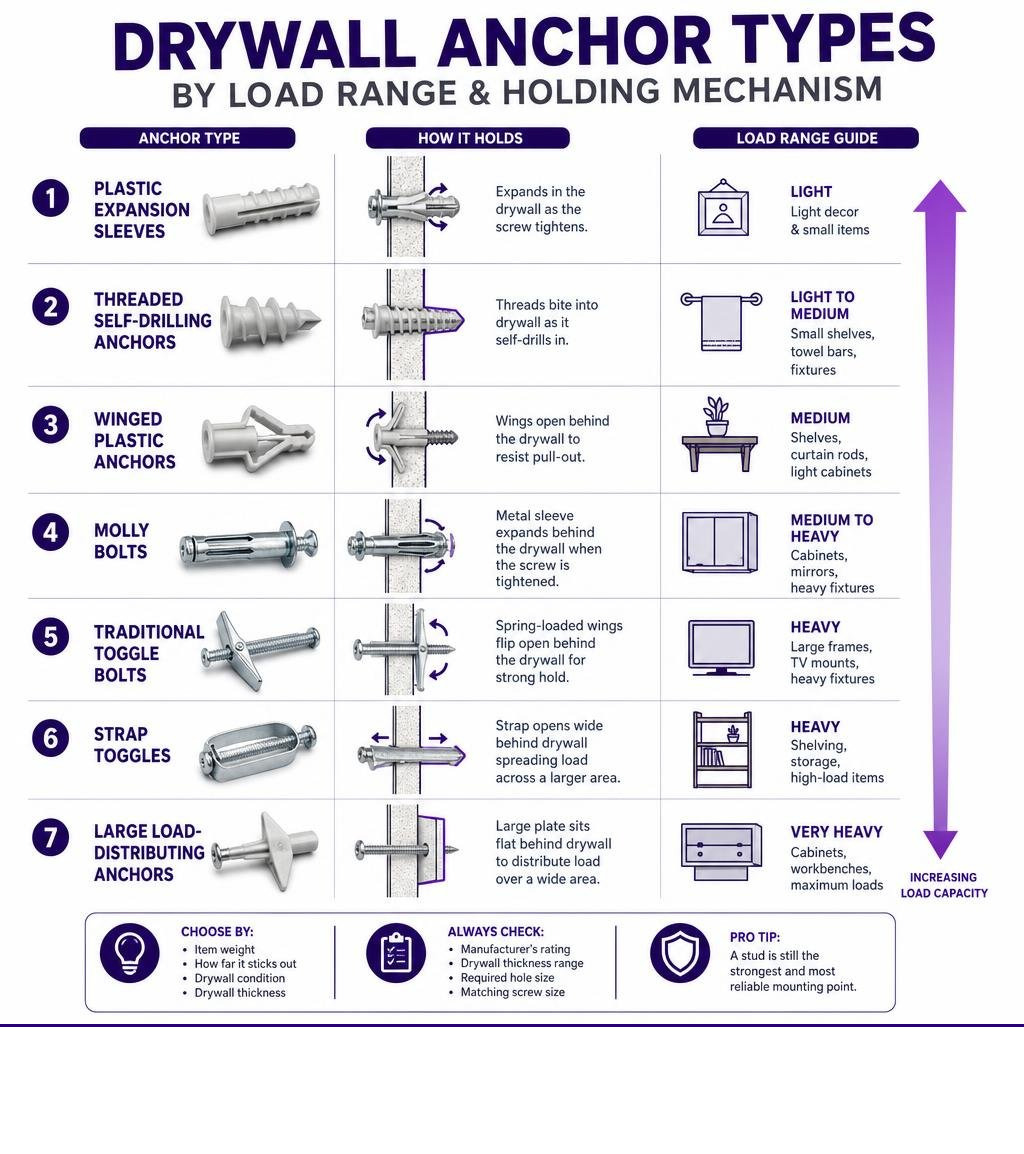
The main drywall anchor types are plastic expansion sleeves, threaded self-drilling anchors, winged plastic anchors, molly bolts, traditional toggle bolts, strap toggles, and large load-distributing anchors. Choose by the item’s weight, how far it sticks out from the wall, and whether your drywall is sound 1/2-inch or 5/8-inch board.
- Light decor: plastic expansion sleeves or small threaded anchors.
- Medium fixtures: self-drilling anchors, winged anchors, or molly bolts.
- Heavy, flush-mounted fixtures: toggle bolts or strap toggles that spread force across the back of the drywall.
- Shelves and other projecting items: size up. Their forward pull creates rotational force, so a published shear rating does not equal safe pull-out capacity.
A stud is still the best mounting point when one is available. Without a stud, the right anchor works by gripping the gypsum core, expanding behind the board, or distributing load over a wider area. Check the manufacturer’s rating, drywall-thickness range, required hole size, and matching screw before installation.
I’m Trevor Jones, and I have more than 16 years of experience in entrepreneurship, marketing, and technology focused on practical building hardware. In this guide to what are the different types of drywall anchors, I’ll help you understand how each style holds, where it can fail, and how to make a sound choice.
What Are the Different Types of Drywall Anchors and How Do They Work?
Standard wood framing studs sit 16 to 24 inches apart behind interior walls. When your mounting points do not align with a stud, driving a standard screw directly into sheetrock fails. Drywall consists of a compressed gypsum plaster core faced with paper. Standard screw threads strip the soft gypsum instantly under load, pulling loose and crumbling the core.
Hollow-wall anchors work by overcoming this mechanical weakness. To select the right hardware, you must distinguish between two primary forces:
- Shear Load (Downward Force): The gravitational pull acting parallel to the wall face. Flush-mounted items, like thin picture frames or flat mirrors, exert almost pure shear load.
- Tensile / Pull-Out Load (Forward Force): The force pulling perpendicular to the wall face. Deep items, like floating shelves, apply a cantilevered rotational stress that pulls outward on the top anchor while pushing inward at the bottom.
Note: Published manufacturer weight ratings reflect static shear loads on vertical walls. They do not represent tensile pull-out capacity for deep, projecting items.
| Anchor Type | Typical Drill Bit Size | Safe Shear Working Load (1/2″ Drywall) | Primary Holding Mechanism |
|---|---|---|---|
| Plastic Expansion Sleeve | 3/16″ to 1/4″ | 5 to 25 lbs | Radial expansion & friction against borehole |
| Threaded Self-Drilling | None (Self-tapping) | 25 to 75 lbs | Deep external thread bite into gypsum |
| Winged Plastic Anchor | 1/4″ to 5/16″ | 25 to 65 lbs | Mechanical butterfly flange compression |
| Steel Molly Bolt | 1/4″ to 3/8″ | 25 to 95 lbs | Collapsible metal casing legs behind board |
| Spring-Wing Toggle Bolt | 3/8″ to 1/2″ | 100 to 150 lbs | Spring-loaded steel wing distribution |
| Solid-Channel Strap Toggle | 1/2″ | 80 to 265 lbs | Solid metal backing channel held by ratchet strap |
| Load-Distributing Plate (GS1/GS2) | 1″ or 2″ Hole Saw | 250 to 1,000 lbs shear | Broad perimeter face compression |
Exploring What Are the Different Types of Drywall Anchors for Light Loads
Standard plastic expansion sleeves (often conical or ribbed plugs) are the most basic hollow-wall fasteners. When you drive a sheet metal screw into a pre-drilled plastic sleeve, the screw forces the split halves outward.
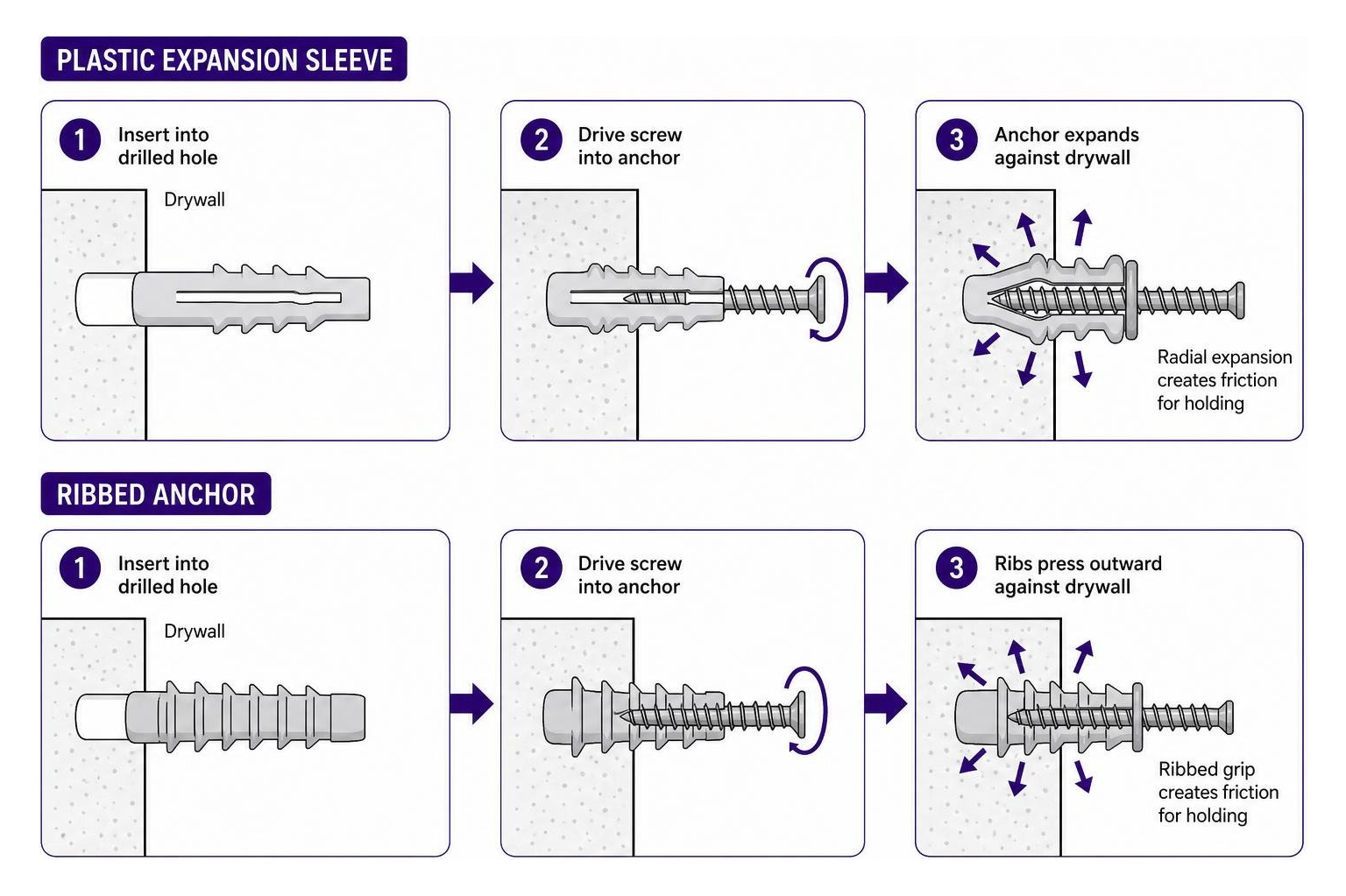
In solid masonry or concrete, this radial pressure creates exceptional holding power. However, inside hollow drywall, expansion sleeves rely purely on light friction against the soft gypsum borehole. If an item exceeds 10 to 25 pounds, or experiences dynamic movement, the sleeve crushes the gypsum core and pulls out cleanly. Use plastic plugs strictly for lightweight items like small picture frames, smoke detectors, and small thermostat housings. Learn more about light-duty options in 10 Types of Hollow Wall and Drywall Anchors and How to Choose One .
Self-Drilling and Threaded Drywall Anchors
Self-drilling threaded anchors feature a wide, coarse outer thread along a tapered body made from cast zinc alloy or glass-filled engineered nylon. They require no pre-drilling.
You drive the anchor directly into the drywall using a manual screwdriver or low-speed drill. The wide exterior threads bite directly into the gypsum, distributing shear weight across a wider radius than a traditional screw.
- Capacity: Rated for 25 to 75 pounds of static shear load in sound 1/2-inch drywall.
- Common Failure Mode: Over-torquing during installation. Driving the anchor too fast with a power drill strips the internal drywall threading, leaving the anchor spinning freely with zero holding power.
Winged Plastic Anchors and Expanding Hollow Wall Plugs
Winged plastic anchors bridge the gap between simple friction plugs and mechanical toggles. After inserting the anchor into a pre-drilled hole, driving the screw draws the flexible plastic “wings” outward, compressing them firmly against the back face of the drywall.
Certain variants use a dedicated push-pin or setting key to pop open the wings behind the board before the screw is inserted. These anchors hold between 25 and 65 pounds in drywall and also function effectively in thin hollow-core doors (1/8-inch to 1/4-inch wood paneling). They are ideal for bathroom towel bars, lightweight curtain brackets, and decorative wall clocks.
Steel Molly Bolts and Sleeve Hollow-Wall Anchors
A molly bolt consists of a slotted metal sleeve, an internal machine screw, and an outer anti-rotation collar with sharp prongs that bite into the drywall paper.
When you tighten the central machine screw, the slotted metal sleeve collapses outward into four rigid legs, clamping tightly against the back face of the drywall.
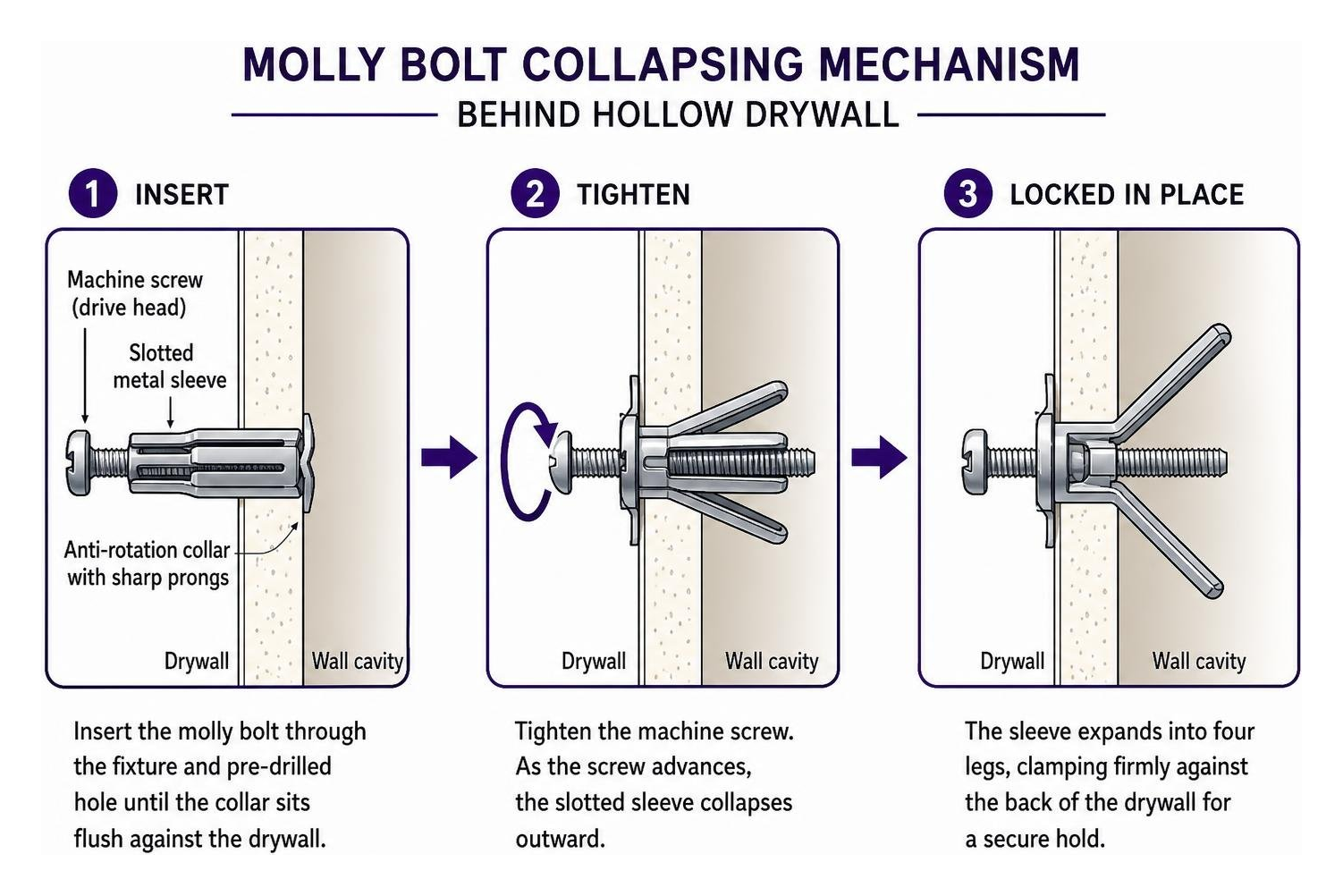
- Capacity: Supports 25 to 95 pounds of static shear load in standard 1/2-inch or 5/8-inch drywall.
- Key Advantage: Unlike standard toggle bolts, the internal machine screw can be removed and re-inserted repeatedly without losing the collapsed anchor casing inside the wall cavity.
- Common Failure Mode: The anchor collar spinning on the wall surface during initial tightening, tearing a wide hole in the front paper face.
Heavy-Duty Toggle Bolts and Strap Toggles
Toggle bolts provide substantial holding capacity for heavy hollow-wall mounting. They divide into two distinct styles:
- Spring-Wing Toggle Bolts: Feature spring-actuated metal wings threaded onto a machine screw. You must feed the bolt through your mounting bracket before compressing the wings and inserting them through a large pre-drilled hole (typically 3/8-inch to 1/2-inch). Once inside the cavity, the wings snap open. You pull the bolt toward yourself to create friction while tightening the screw.
- Solid-Channel Strap Toggles (Snap Toggles): Feature a solid metal channel connected to plastic guide straps. You slide the metal channel through a 1/2-inch hole, pull the straps flat against the back of the drywall, slide the outer cap flush, and snap off the excess plastic. This locks the threaded channel permanently in place, allowing single-person fixture installation.
Toggle systems support 80 to 265 pounds of static shear load in 1/2-inch drywall. For more detailed mechanical comparisons, review Types of Wall Anchors and How to Choose the Right One for Drywall .
Advanced Load-Distributing Drywall Anchors
When static shear loads exceed standard toggle limits, specialized load-distributing drywall anchors provide an engineered solution without requiring access to a framing stud.
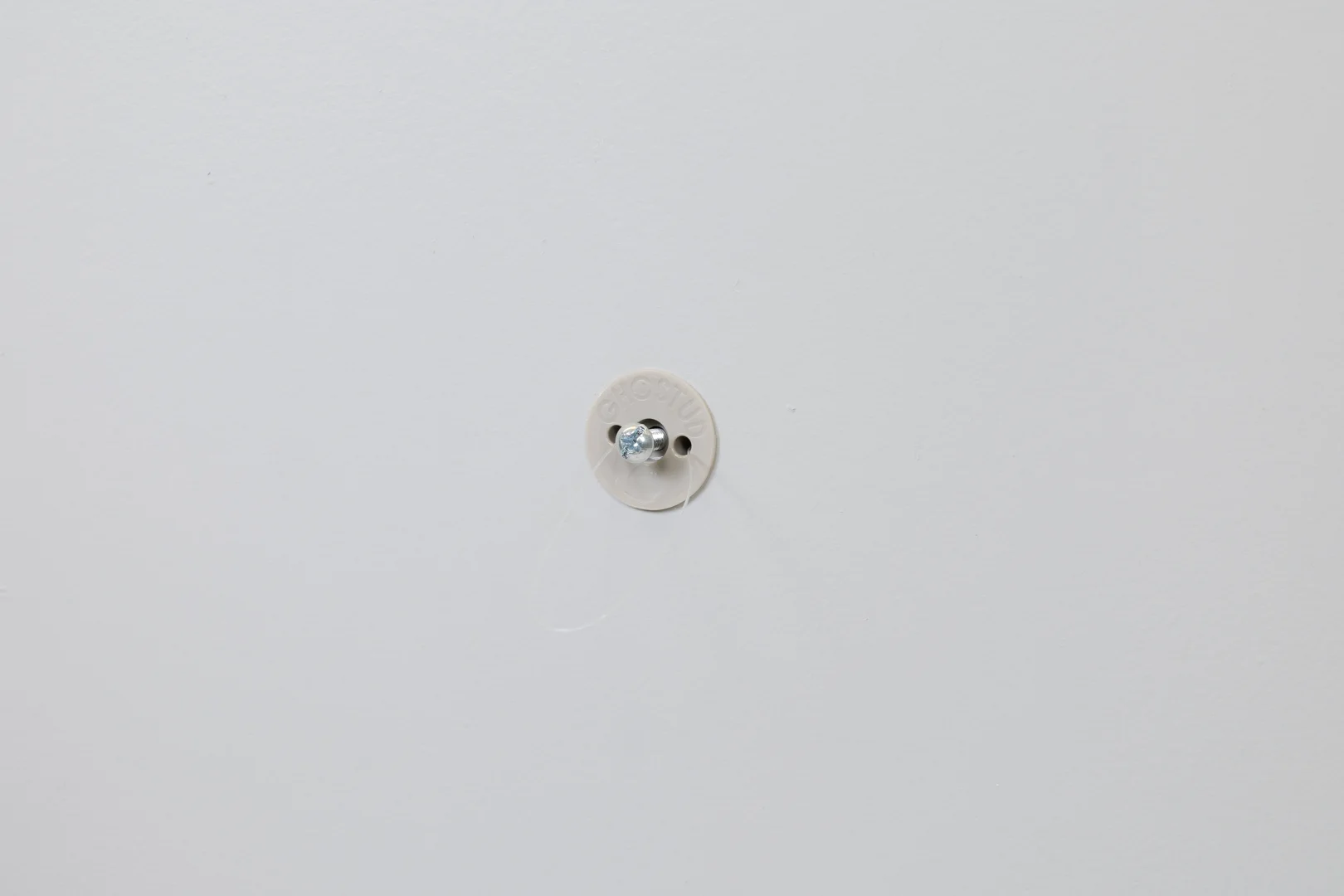
Our patented GS1 Ghostud Drywall Anchor installs using a standard 1-inch hole saw and supports up to 250 pounds of static shear load in 1/2-inch or 5/8-inch drywall. For heavy commercial and residential installations, the GS2 Drywall Anchor installs using a 2-inch hole saw to support up to 1,000 pounds of static shear load in sound 1/2-inch or 5/8-inch drywall.
Manufactured in the USA from 100% recycled structural plastic and sold in 2-packs and 20-packs, these anchors clamp the drywall around a broad perimeter. Instead of focusing stress onto a single puncture point, they distribute mechanical load across a wide surface area of the gypsum panel.
How to Choose the Right Drywall Anchor for Your Project
Selecting the correct fastener prevents structural wall failures. Follow these evaluation criteria before drilling:
- Calculate the Total Static Load: Weigh the object on a scale. Always build in a 25% to 50% safety margin. If your framed mirror weighs 30 pounds, select hardware rated for at least 40 to 45 pounds.
- Assess Cantilever Forces: A 20-pound decorative plate mounted flush applies almost pure downward shear force. A 20-pound floating shelf extending 10 inches outward creates severe rotational leverage, pulling outward at the top. Size up your anchor capacity accordingly.
- Verify Drywall Thickness and Soundness: Standard residential walls use 1/2-inch gypsum board; commercial or fire-rated walls typically use 5/8-inch board. Verify that the drywall core is dry, firm, and free of water damage or soft crumbling patches.
Comparing Drywall Anchors by Weight Rating
- Light Duty (0 to 25 lbs): Wall clocks, small picture frames, smoke detectors, canvas art. Use plastic expansion plugs or small self-drilling nylon anchors.
- Medium Duty (25 to 75 lbs): Towel racks, medium mirrors, decorative clocks, light shelving units. Use metal self-drilling anchors, winged plastic anchors, or standard molly bolts.
- Heavy Duty (75 to 250+ lbs shear): Large framed art, heavy mirrors, audio-visual mounts, hanging cabinetry brackets. Use heavy-duty toggle bolts, solid-channel strap toggles, or broad load-distributing plate anchors in sound 1/2-inch or 5/8-inch board.
Plastic vs. Metal Drywall Anchors: Pros and Cons
| Anchor Material | Advantages | Disadvantages | Best Applications |
|---|---|---|---|
| Plastic / Nylon | Non-corrosive, non-conductive, budget-friendly, installs easily without surface marring | Lower shear strength, drive heads can strip under high torque, prone to permanent plastic deformation | Bathrooms, kitchens, lightweight wall decor, smoke detectors |
| Metal (Zinc / Carbon Steel) | Higher shear strength, heat-resistant, durable drive heads, handles higher clamping tension | Can corrode in high-moisture environments, requires larger drill holes, harder to remove cleanly | Heavy flush mirrors, deep wall cabinets, high-load shear brackets |
Step-by-Step Drywall Anchor Installation and Removal
Proper installation technique ensures the anchor engages the gypsum core without fracturing it.
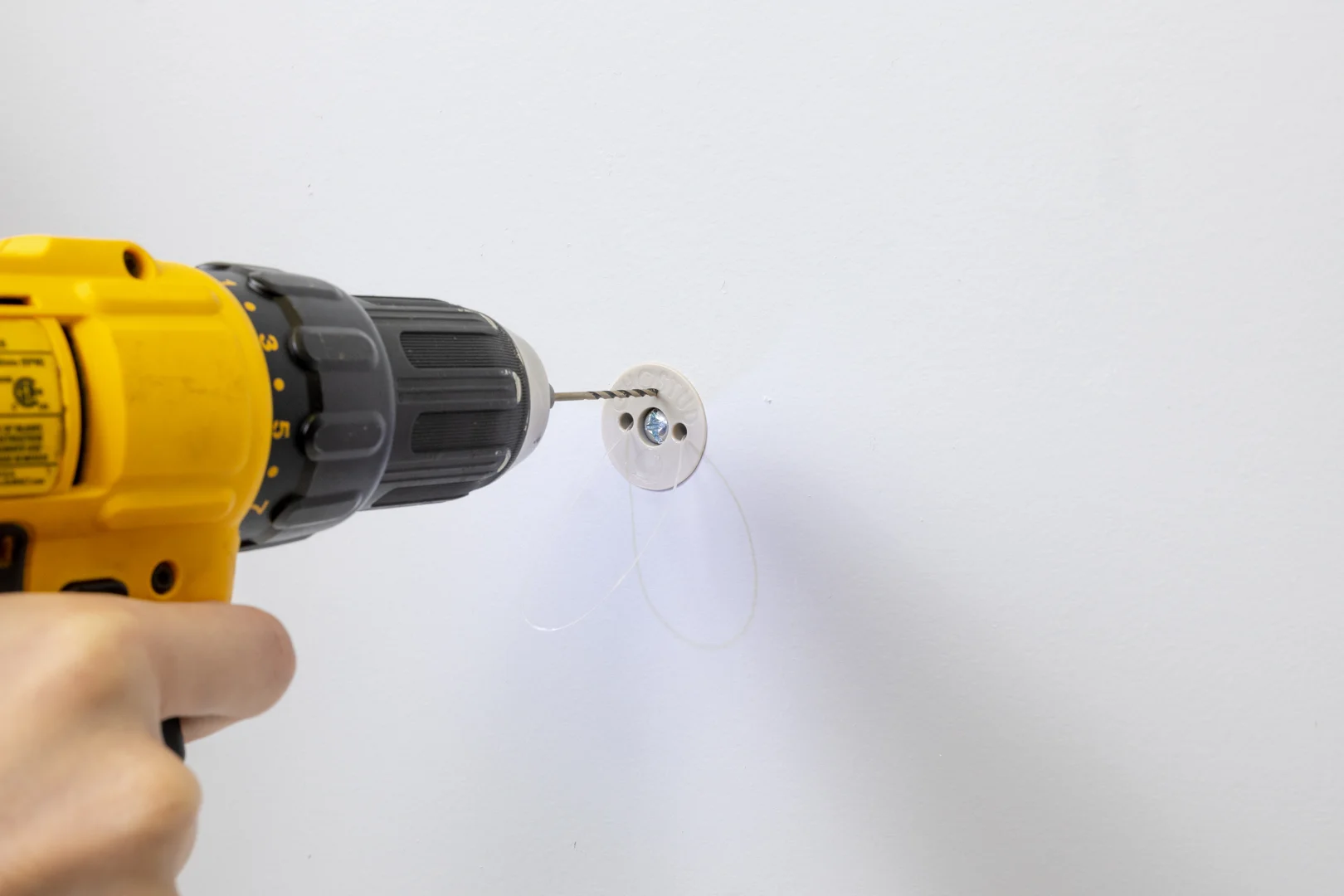
General Installation Procedure:
- Mark Your Layout: Use a pencil and a bubble level to mark your mounting locations. Use a stud finder to confirm you are working in a hollow wall cavity rather than hitting a hidden stud or utility pipe.
- Drill the Pilot Hole: Match the drill bit diameter precisely to the anchor package instructions. A practical visual check: hold the drill bit directly behind the anchor body. The bit should match the central shaft width while leaving the anchor’s external threads or retention ribs visible. Keep the drill perpendicular to the wall without wobbling.
- Insert the Fastener:
- For plastic sleeves or molly bolts, tap the collar flush with the wall face using light taps from a rubber mallet.
- For self-drilling anchors, drive the fastener slowly using a manual screwdriver until the head sits flush with the drywall paper.
- For detailed procedures on advanced hardware, review our Install Guide.
- Secure the Fixture: Drive the screw by hand. Stop turning immediately once firm resistance is felt. Over-torquing will strip the gypsum or snap the anchor collar.
Removing Anchors and Repairing Damaged Drywall
When you redecorate or move, use the correct extraction method for the specific anchor type:
- Threaded Anchors: Back the anchor out cleanly by turning it counter-clockwise with a manual screwdriver.
- Plastic Expansion Sleeves: Thread a screw 2 to 3 turns into the sleeve, grip the screw head with pliers, and pull straight out.
- Permanent Molly Bolts & Toggles: Because rear flanges cannot collapse backward through the hole, place a nail set or wide punch against the center of the outer collar. Tap it firmly with a hammer until the metal rim breaks or recesses below the drywall surface, letting the rear casing drop into the wall cavity.
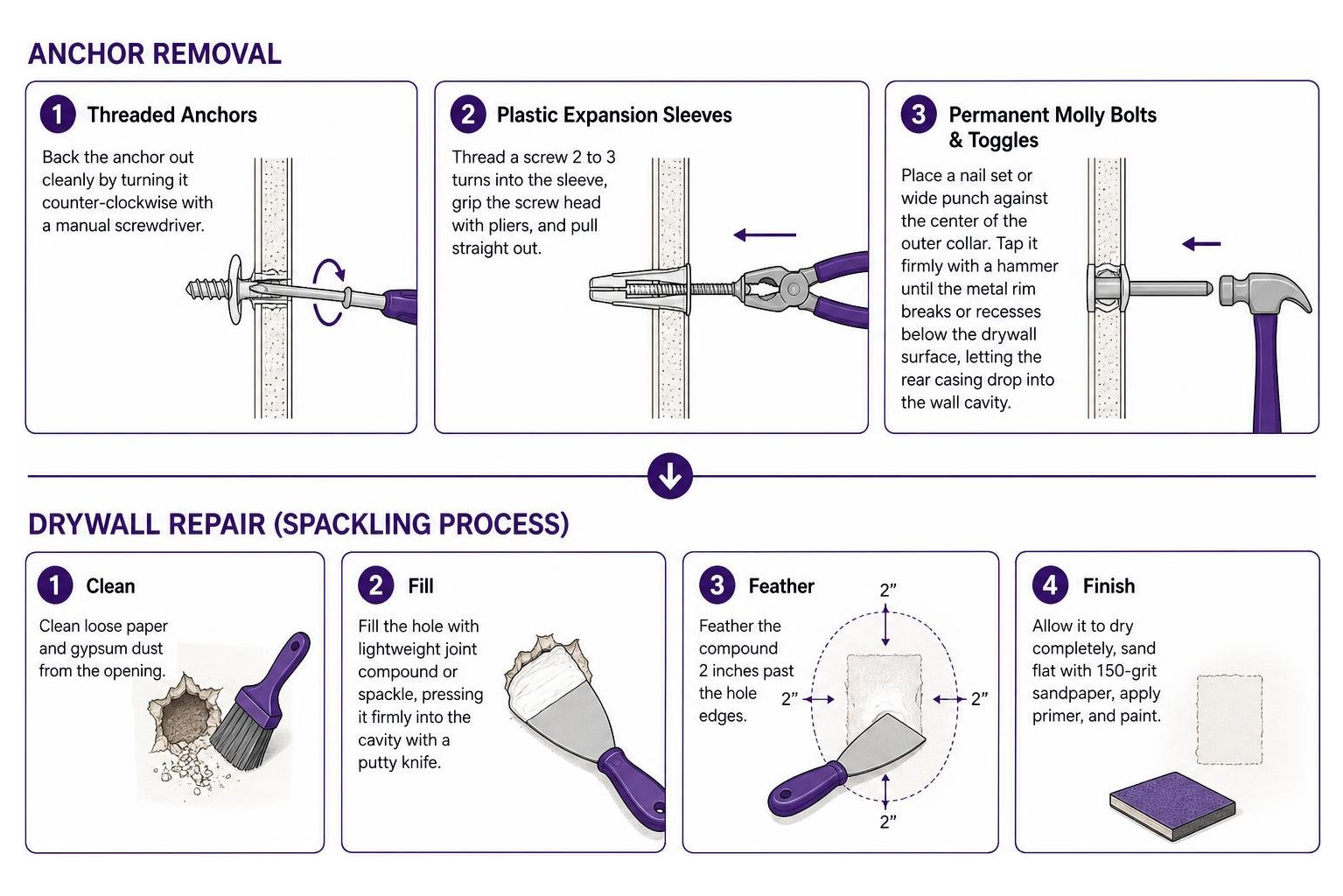
Repairing the Hole:
- Clean loose paper and gypsum dust from the opening.
- Fill the hole with lightweight joint compound or spackle, pressing it firmly into the cavity with a putty knife.
- Feather the compound 2 inches past the hole edges.
- Allow it to dry completely, sand flat with 150-grit sandpaper, apply primer, and paint.
Common Anchor Mistakes to Avoid
- Drilling Oversized Pilot Holes: Drilling a loose hole prevents expansion anchors and molly bolts from gripping, causing them to spin freely when the screw is driven.
- Using High-Speed Power Drills: Driving threaded anchors with a high-speed drill creates extreme friction that pulverizes the soft gypsum core into fine powder, eliminating mechanical thread bite.
- Treating Shear Load as Pull-Out Strength: Never assume an anchor rated for 75 pounds of static shear can support a 75-pound floating shelf. The rotational leverage pulls the top fastener outward with magnified tensile force.
- Mounting into Damaged Gypsum: Soft, water-damaged, or heavily patched drywall lacks the tensile strength to support hollow-wall fasteners.
- Improper Anchor Selection on Ceilings: Never use friction-based plastic expansion plugs or self-drilling screw anchors on ceilings. Gravity exerts continuous downward pull-out tension, demanding mechanical behind-the-wall clamping fasteners like toggle bolts.
When Drywall Anchors Are the Wrong Choice
Drywall anchors are engineered specifically for hollow gypsum assemblies. There are specific structural situations where using a hollow drywall anchor is inappropriate:
- When a Structural Wood Stud Is Present: If your layout aligns with a solid 2×4 stud, do not use a hollow-wall anchor. Drive a standard wood screw directly into the center of the stud for maximum mechanical support.
- Masonry, Brick, Plaster, or Tile Substrates: GHOSTUD anchors and standard hollow drywall toggles are engineered exclusively for 1/2-inch and 5/8-inch gypsum drywall. When working with plaster and lath, masonry, brick, or tile backer board, stop your installation and switch to substrate-specific masonry sleeves or structural concrete screws.
- Human Support and Safety-Critical Applications: Never use drywall anchors for grab bars, safety rails, handrails, fall-prevention equipment, or any fixture intended to support human body weight. These installations require structural backing attached directly to building framing members according to local building codes.
Frequently Asked Questions About Drywall Anchors
Can drywall anchors be reused after removal?
Plastic expansion sleeves and self-drilling nylon anchors cannot be reliably reused. Driving a screw deforms the plastic body permanently; removing the fastener strips its interior threads and compromises gripping power. Metal molly bolt casings are permanently deformed behind the drywall and cannot be extracted for reuse. Traditional toggle wings drop into the wall cavity once the machine screw is backed out completely. Always install fresh hardware for new mounting locations.
Why do drywall anchors pull out or loosen over time?
Anchors loosen over time due to three primary mechanical causes:
- Dynamic Vibration: Daily movement (such as pulling towels from a bar or shutting doors nearby) slowly fatigues the gypsum core surrounding friction-fit anchors.
- Tensile Pull-Out Forces: Projecting brackets create rotational leverage that continuously pulls outward on the anchor head.
- Core Degradation: Humid environments or oversized pilot holes degrade the structural cohesion of the compressed gypsum, widening the borehole until the anchor slips forward.
When should you use a toggle bolt instead of a self-drilling anchor?
Use a toggle bolt whenever the static fixture weight exceeds 50 to 75 pounds, when mounting directly overhead into a drywall ceiling, or when the mounted object projects outward from the wall face. Self-drilling anchors rely entirely on the integrity of the gypsum core threads, making them vulnerable to pull-out failure under forward tension. Toggle bolts bypass the gypsum core, clamping a wide steel wing or solid channel directly against the backside of the drywall panel for superior load distribution.
Conclusion
Selecting the right drywall fastener comes down to matching hardware mechanics to your fixture weight and wall conditions. For lightweight decorative frames, standard plastic sleeves or self-drilling threaded anchors provide fast installation. For medium-weight mirrors and shelving brackets, steel molly bolts and winged anchors deliver reliable stability. When mounting heavy static loads on sound 1/2-inch or 5/8-inch drywall without access to framing studs, mechanical toggle bolts and engineered load-distributing systems like GHOSTUD provide the broad perimeter surface clamping required to prevent wall damage. Always verify your drywall condition, account for forward rotational forces, and follow manufacturer load specifications before drilling.