
Best Plasterboard Fixings for Shelves: Start With the Wall
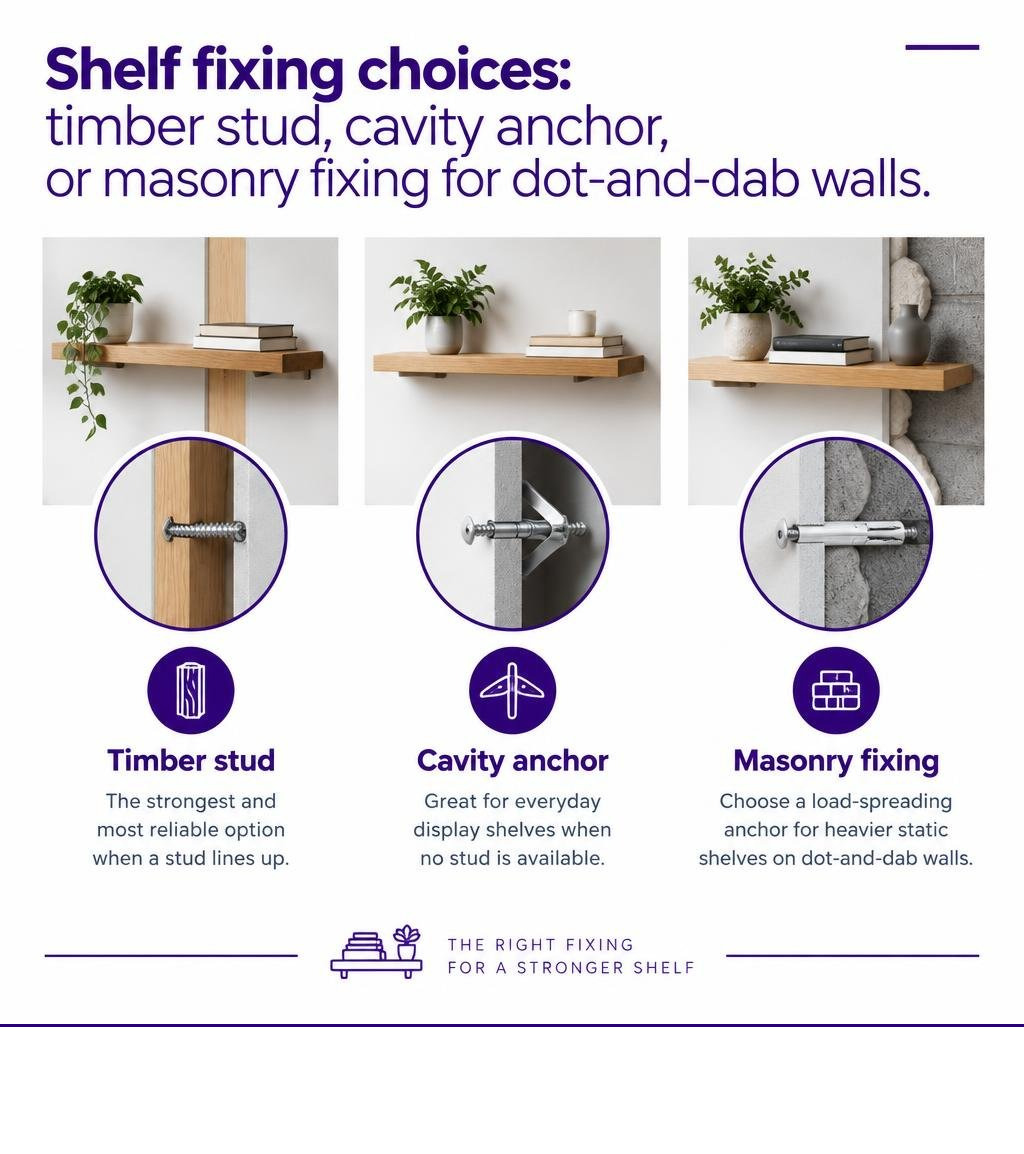
Fix into a timber stud if you can. If no stud lines up, use expanding metal cavity anchors for everyday display shelves. For heavier static shelves on hollow drywall, choose a load-spreading anchor with enough space to open behind the board. Check the maker’s load guidance for your board and bracket. A deep shelf pulls its top fixings outward, so a high shear rating alone does not tell you how much the shelf can hold.
For 1/2 in or 5/8 in drywall, light shelving calls for a 1-inch hole-size anchor rated up to 250 lb, while heavy static shelving calls for a 2-inch hole-size anchor rated up to 1,000 lb shear. Do not use drywall anchors on plaster, lath, concrete, masonry, brick, stucco, tile over backer board, or metal studs. For those surfaces, or a dot-and-dab wall backed by masonry, choose a fixing designed for the material behind the board.
Mechanics of Shelf Loading: Shear vs. Axial Forces on Drywall
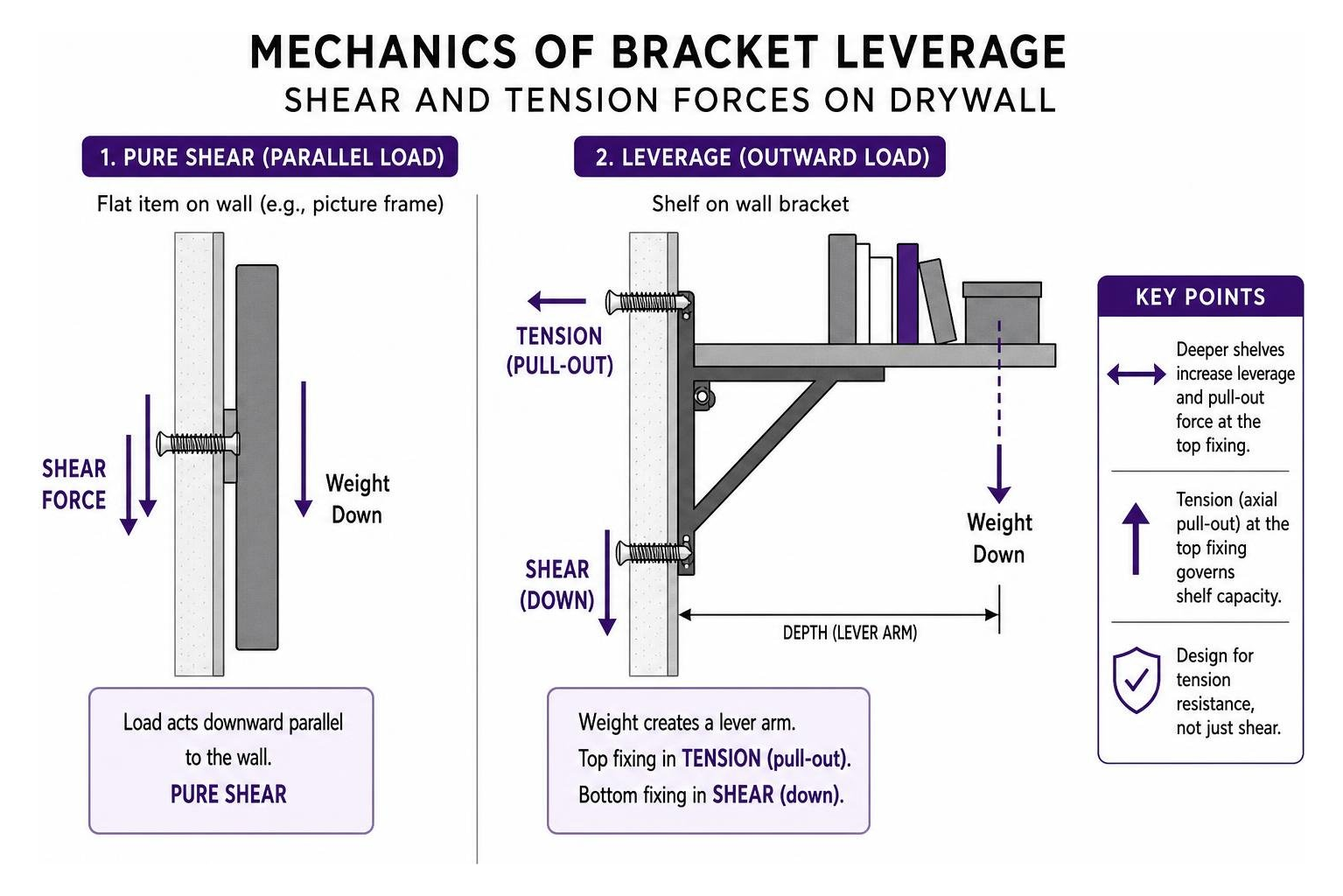
When you mount a flat picture frame, the weight pulls downward parallel to the wall. This is a pure shear load. Shelves behave differently. Because a shelf projects outward from the wall, it acts as a lever arm. Gravity pulls the shelf contents down, which forces the bracket to pivot forward against the bottom screw while placing the top fixing under intense tension (axial pull-out force).
The deeper the shelf, the higher this leverage multiplier becomes. A 200 mm deep shelf loaded with 10 kg of books creates far more pull-out force at the top anchor than a shallow 100 mm picture ledge with the exact same weight. To secure a heavy shelf without pull out failure, you must calculate your anchor choices based on tension resistance, not just downward capacity.
Reviewing our guide on strongest drywall anchor guide shear ratings explained helps clarify why manufacturer ratings can be misleading. A standard metal anchor might boast a high shear rating, but under axial tension, standard 12.5 mm plasterboard typically experiences gypsum blowout around 40 kg to 60 kg of direct pull-out force.
Always apply an engineering safety factor of at least 3 to published failure loads. If an anchor datasheet claims a maximum failure load of 45 kg, treat its real-world safe working load as no more than 15 kg per point.
How to Install Shelf Anchors in Plasterboard Step-by-Step
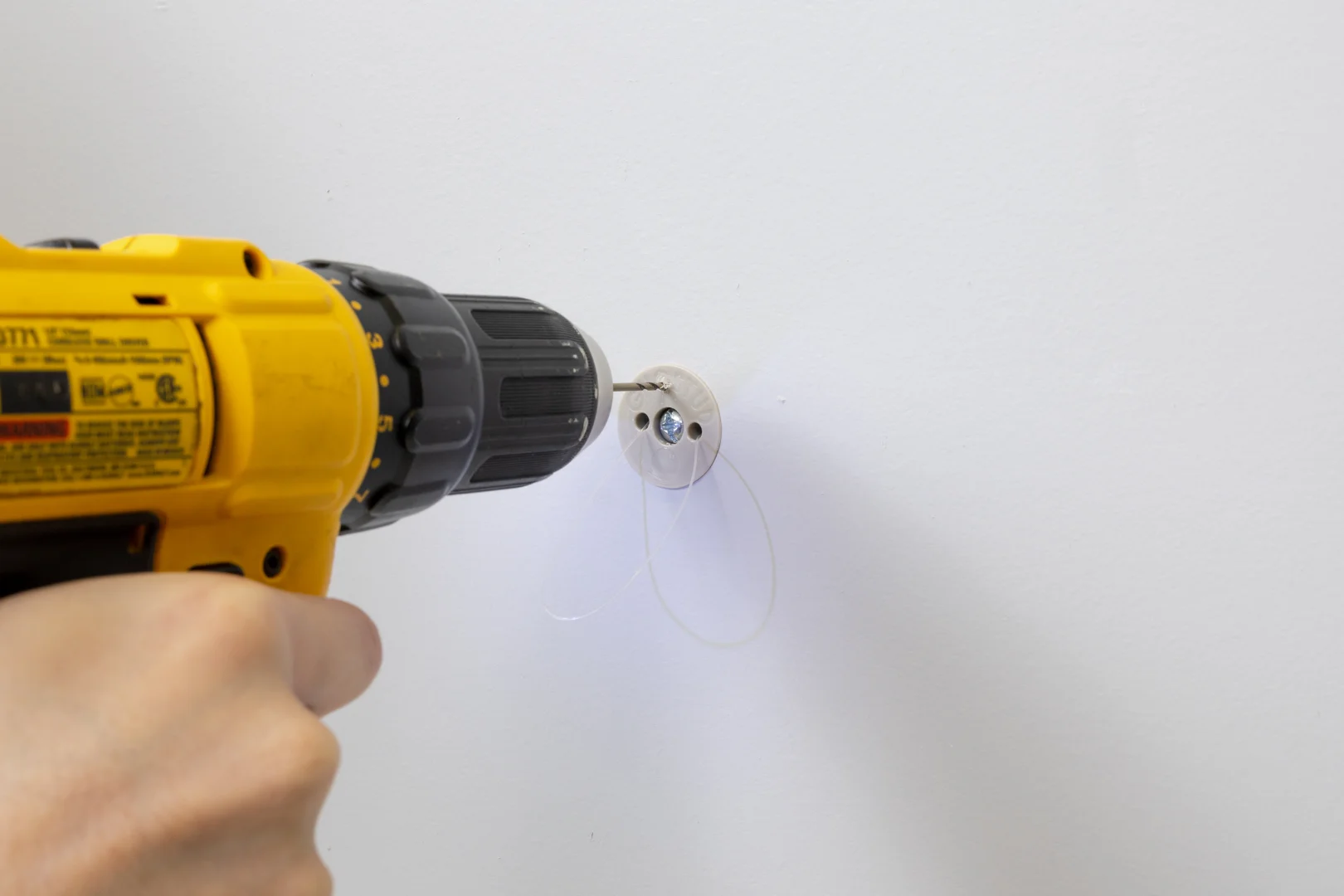
Follow these exact steps to mount heavy shelves safely without sagging or pull out:
- Scan the wall: Run a multi-scanner across the target area to locate live electrical cables, pipework, and internal studs. UK timber studs generally sit at 400 mm or 600 mm centres.
- Mark bracket points: Hold your shelf bracket against the wall and use a spirit level to verify true horizontal alignment. Mark the fixing holes with a sharp pencil. Keep every hole at least 50 mm away from any plasterboard edges.
- Drill the pilot hole: Chuck an HSS or brad-point wood drill bit into your drill. Do not use hammer mode. Drill straight through the paper face into the gypsum core using light, steady pressure.
- Insert and set the fixing: Push your chosen hollow-wall anchor into the hole until the outer collar sits flush against the board. If you are using expanding metal hollow-wall anchors (M5 or M6), use a dedicated setting tool to collapse the legs behind the board. Never rely solely on a standard screwdriver to set them, as the anchor head will spin and grind away the gypsum core.
- Secure the bracket: Place the bracket over the anchors and drive the machine screws home using low clutch torque to avoid crushing the board.
Ranking the Best Plasterboard Fixings for Shelves by Weight Class
To choose correctly, learn how to select the right drywall anchor for your load and check the what screws for plasterboard? The complete UK guide 2026 for fastener thread standards.
| Anchor Type | Best Application | Safe Working Load (12.5mm Drywall) | Min. Cavity Depth Required | Reusable? |
|---|---|---|---|---|
| Plastic Expansion Plug (e.g. Fischer DuoPower) | Very light decor, small picture ledges | 5–10 kg per bracket | 20 mm | No (Sleeve permanent) |
| Expanding Metal Anchor (M5 / M6 Molly) | Medium display shelves, small book stacks | 15–20 kg per fixing | 30 mm | Yes (Screw removable) |
| Spring Toggle Bolt | Medium-to-heavy wide shelves | 20–30 kg per fixing | 35 mm | No (Wings drop if undone) |
| Heavy-Duty Winged Anchor (e.g. Bullfix, Gripit) | Heavy static shelves, wide bookcases | 40–50 kg per fixing | 20–35 mm | Limited |
| GHOSTUD GS2 | Heavy static shelving, wide spans | Up to 1,000 lb shear in 1/2 in or 5/8 in drywall | 25 mm behind board | Permanent installation |
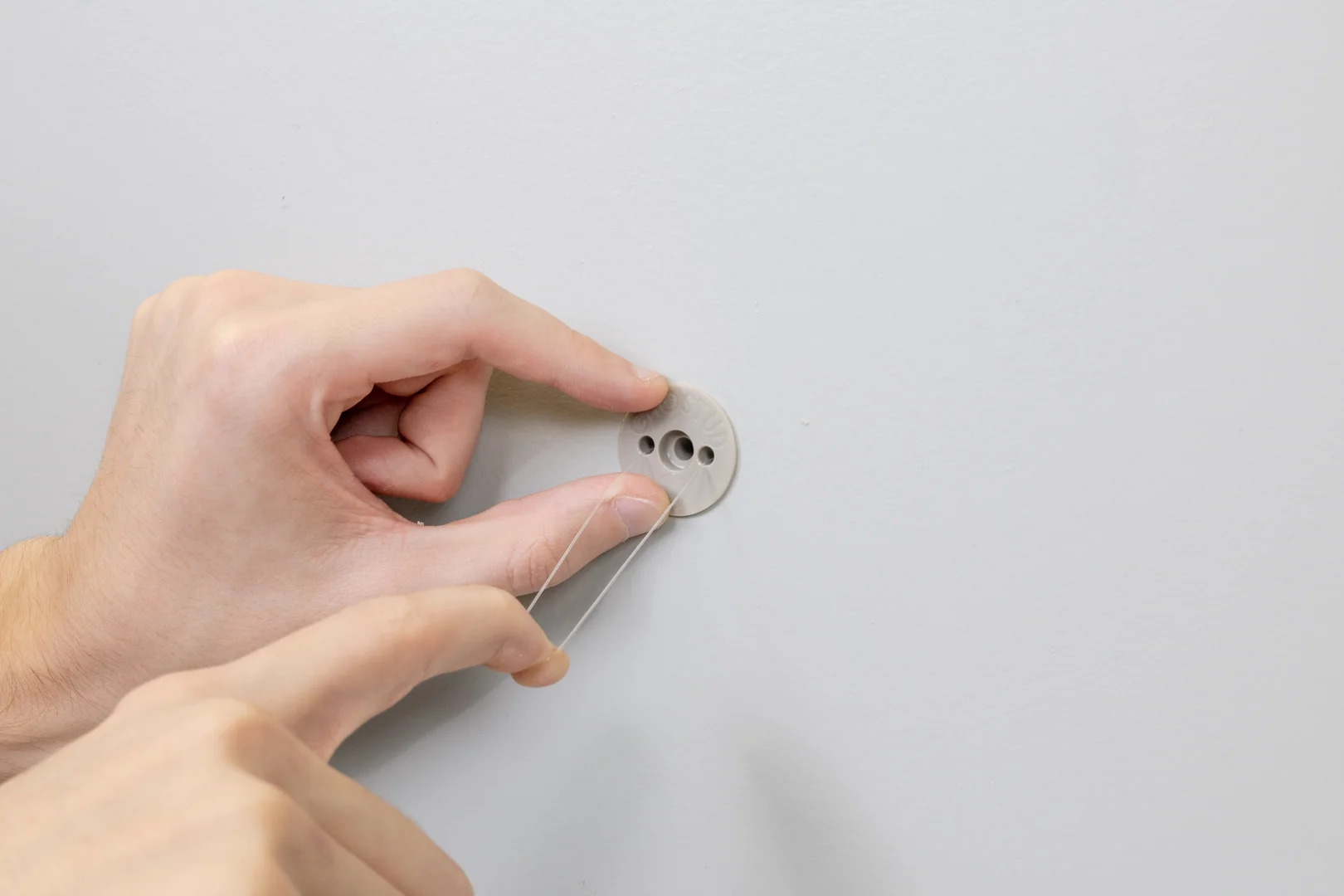
Mounting something heavy where there’s no stud? GHOSTUD® spreads the load across the drywall with a wide backplate instead of relying on the gypsum core. GS1 holds up to 250 lb shear, GS2 up to 1,000 lb. Made in the USA from recycled structural plastic. Shop GHOSTUD® from $16.99 →
Light Duty Anchors for Display Shelves (Up to 10kg)
For small decorative shelves holding picture frames or lightweight plants, standard commodity fixings work well. The Fischer DuoPower universal nylon plug expands, folds, and knots inside hollow cavities, holding up to 10 kg per bracket in standard 12.5 mm board. Avoid self-drive zinc “speed plugs” for shelving; their aggressive coarse threads chew away the gypsum core when subjected to forward bracket tilt.
Choosing the Best Plasterboard Fixings for Shelves with Medium Loads (10kg to 25kg)
Medium loads require mechanical clamping behind the board. Expanding metal cavity anchors (M5 x 43 mm or M5 x 52 mm) flare out four steel legs against the rear paper face. In destructive pull tests, M5 metal anchors hold between 42.6 kg and 64 kg before the plasterboard fails, giving a safe working load of 15 kg to 20 kg per fixing.
Spring toggle bolts are another classic option. They spread weight across broad steel wings behind the board. You can learn the installation process by reviewing how to anchor a shelf without studs fast by using toggle bolts. When using floating shelves, consult how to fit floating shelves on plasterboard to pair internal bracket rods with proper cavity anchors.
Heavy-Duty Winged Anchors and High-Capacity Solutions (25kg+)
For full rows of books, crockery, or wide shelving spans, choose heavy-duty anchors that grip a broad area of the rear drywall face.
- Bullfix Extra: Uses glass-filled nylon wings requiring a 20 mm hole and a 20 mm rear cavity. In 12.5 mm plasterboard, it provides a maximum recommended tension load of 46 kg and shear load of 98 kg per fixing.
- Corefix Spike: A no-drill wing-expanding metal anchor providing a safe working load of 50 kg per fixing (safety factor of 2) with a minimum rear cavity depth of 35 mm.
- GHOSTUD GS2: When mounting heavy shelving on hollow 1/2 in or 5/8 in drywall without studs, we manufacture the GHOSTUD GS2, which installs with a 2-inch hole saw and is rated up to 1,000 lb shear in 1/2 in or 5/8 in drywall. Made from 100% recycled plastic in the USA, it uses a broad backing plate to eliminate localized gypsum crushing under heavy static loads.
Special Wall Types and Limitations: Dot-and-Dab vs. Studs
Before picking your fixings, confirm your wall structure. Not all plasterboard walls are hollow stud cavities.
- Dot-and-Dab Walls: Plasterboard sheets are fixed to solid masonry (brick or block) using adhesive dabs, leaving a narrow 10 mm to 25 mm gap. Standard hollow cavity anchors (like toggle bolts or expanding wings) cannot open properly in this shallow, glue-obstructed void. For dot-and-dab walls, drill completely through the plasterboard into the solid masonry behind it and secure your shelf with long masonry frame fixings or specialised spacers that bridge the gap without crushing the board.
- Timber Stud Walls: A 5 mm wood screw driven at least 25 mm into a solid timber stud can carry over 50 kg in shear. If you can locate studs at 400 mm or 600 mm intervals, always drive at least one bracket screw directly into the timber.
- Metal Studs: Commercial builds often use light-gauge steel framing. Use fine-thread drywall screws or specialized toggles; do not drive standard wood screws into steel studs.
- Lath and Plaster: Older homes feature thin timber laths covered in lime plaster. Cavity anchors will shatter the brittle keying behind the laths. Secure fixings directly into the main structural timber uprights instead.
Frequently Asked Questions About Plasterboard Shelf Fixings
What Are the Best Plasterboard Fixings for Shelves Without Studs?
Expanding metal hollow-wall anchors (M5 or M6) set with a tensioning tool provide the most dependable hold for medium loads. For heavy loads, use heavy-duty winged fixings or toggle mechanisms that clamp firmly across a wide section of the rear board face.
How Much Weight Can a Floating Shelf Hold on 12.5mm Plasterboard?
A floating shelf on 12.5 mm plasterboard without studs safely holds 10 kg to 15 kg when mounted with quality cavity anchors. Because floating shelf rods concentrate intense pull-out leverage on the top screws, never load a studless floating shelf with dense stacks of hardback books.
Can You Reuse Plasterboard Fixings After Removing a Shelf?
Expanding metal anchors and toggle sleeves remain permanently clamped inside the wall cavity, but their machine screws can be removed and re-threaded to take a new bracket. Self-drive plastic plugs and friction sleeves cannot be reused once removed; patch the hole and drill a fresh location.
Conclusion
Never overload a standard hollow wall with deep, heavy shelving without checking your wall construction and calculating anchor capacity. For comprehensive mounting strategies, read our guide to floating shelves without studs.
Pick up a stud finder, verify your wall cavity depth, and choose a fixing engineered to handle both the downward weight and the outward leverage of your shelf.
Mount it once, mount it right. Compare GS1 and GS2 →