
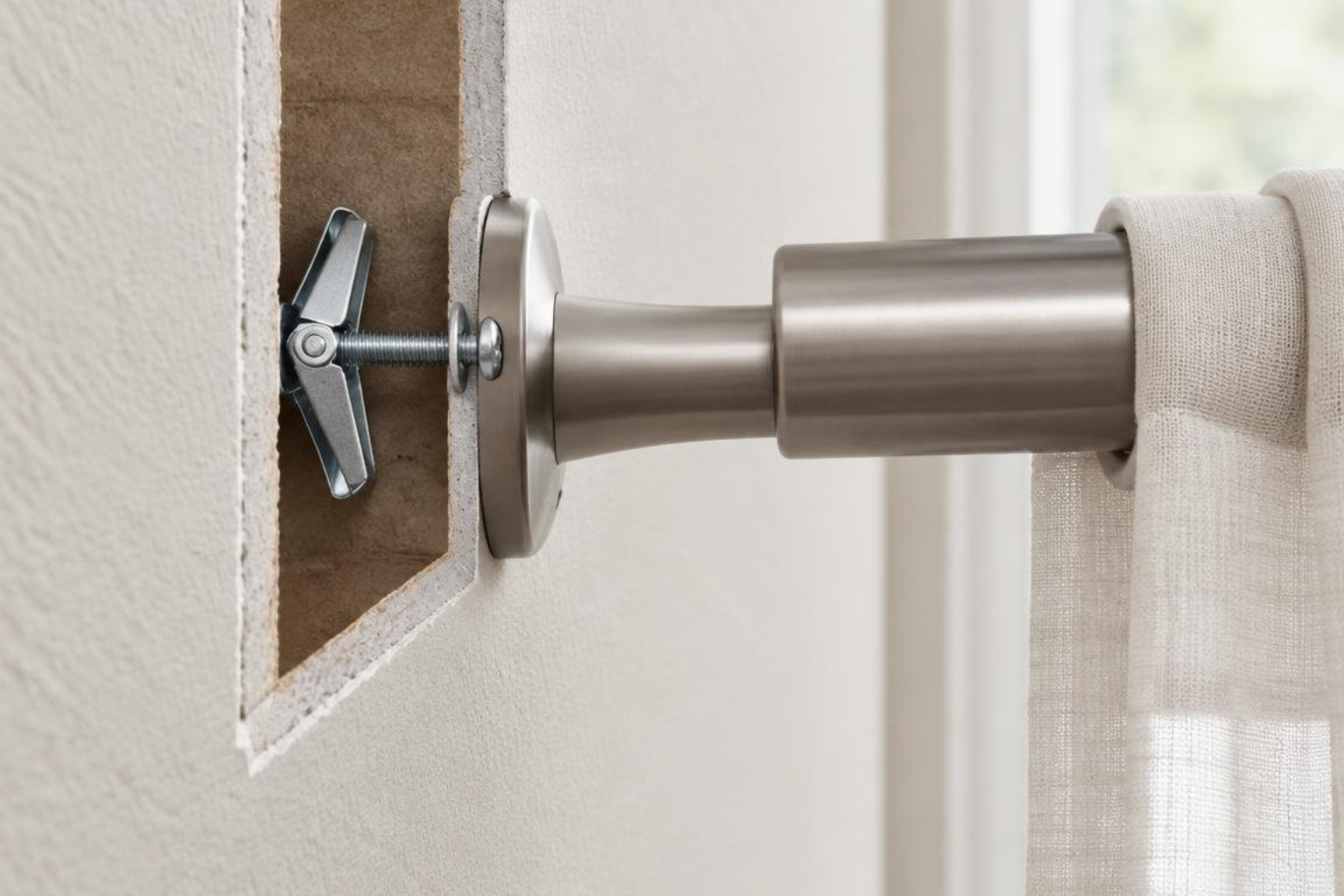
Best Anchor for a Curtain Rod: Start With the Wall
Use a stud if one is in the right spot. If you have only drywall, a self-drilling anchor can suit light sheers, while heavy drapes call for an anchor that spreads the load behind the wall, such as a toggle bolt or a load-distributed plate anchor. Check the weight of the curtains, rod, and hardware before you choose.
Standard plastic plugs can loosen as you open and close the curtains. Each pull puts force on the bracket and can damage the drywall around a weak anchor. Load-distributed plate anchors are for 1/2-inch or 5/8-inch drywall only; use a solution made for your wall if you have plaster, masonry, or another surface.
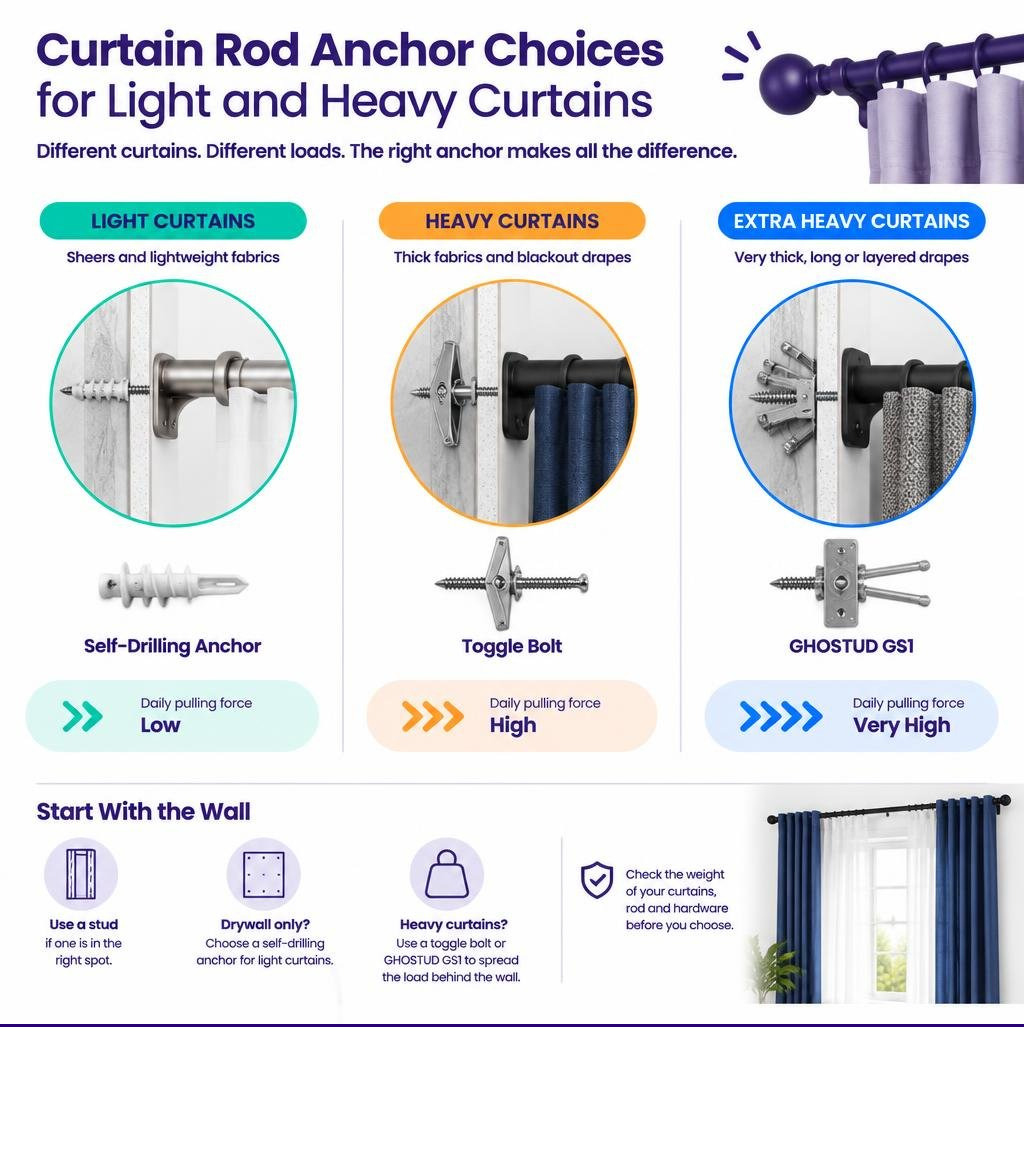
Must-know best anchor for curtain rod terms:
- best drywall anchors for curtain rods
- best wall anchors for curtain rods
- how to hang curtain rods in drywall
The Physics of Curtain Rod Failure: Static Load vs. Dynamic Pull
A plain screw driven straight into 1/2-inch gypsum board holds roughly 5 pounds before the paper face tears and the threads pull free. Drywall is compressed gypsum chalk wrapped in paper sheets. It possesses moderate compressive strength, but its tensile pull-out strength is minimal.
Curtain hardware does not apply a simple static, downward load. When you hang drapery, the mounting bracket acts as a lever arm extending 3 to 5 inches off the wall surface. This offset turns downward gravity into a rotational force that exerts continuous outward tension on the top mounting screw.
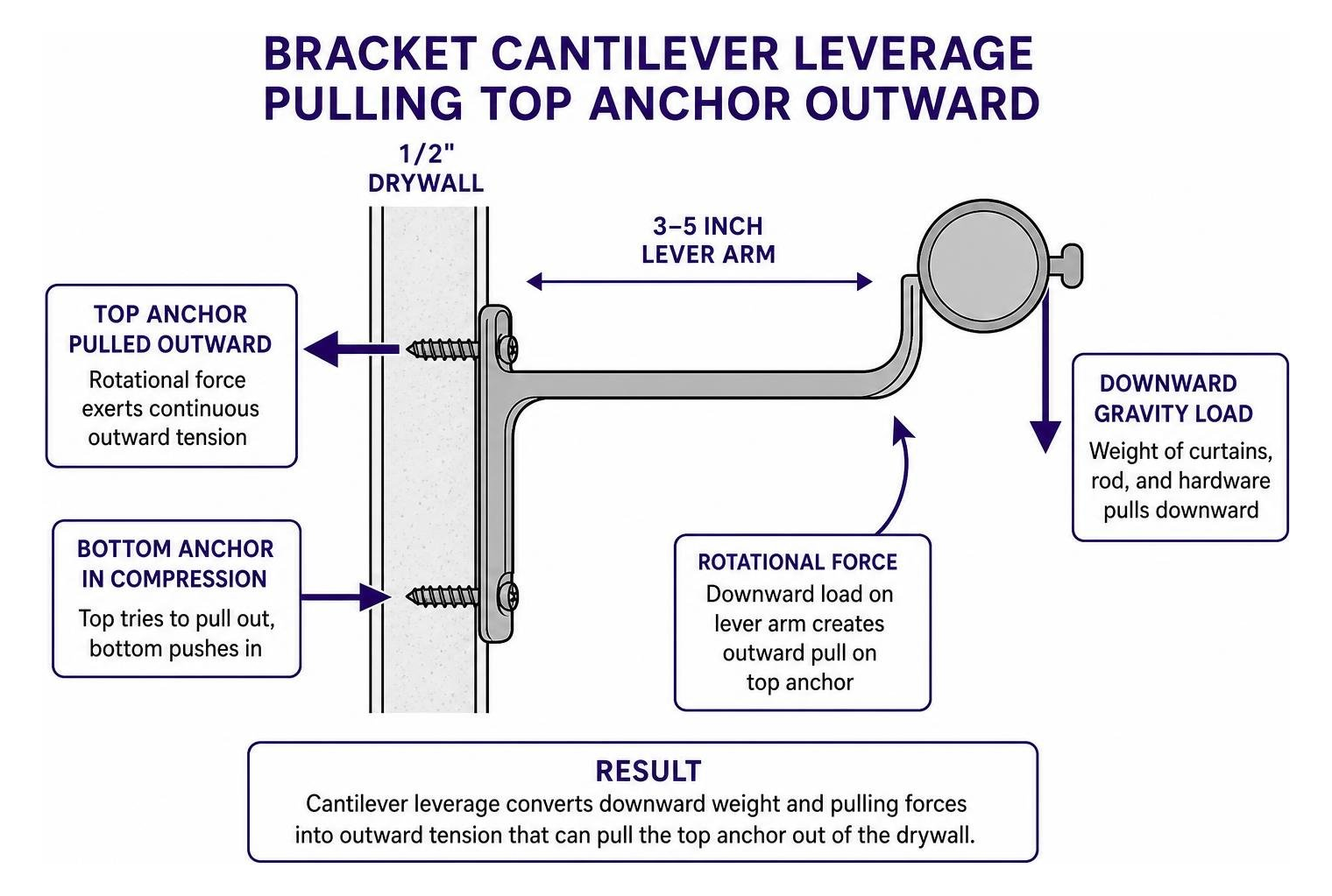
Every time you pull drapes open or closed, you introduce dynamic, cyclic loading. Ring friction, fabric snag, and user pull create lateral and downward forces that spike well beyond the stationary weight of the fabric. In our experience diagnosing why your curtain rod keeps falling and how to fix it, these repetitive dynamic pulls slowly wallow out the gypsum core around undersized fasteners.
Why Included Plastic Conical Anchors Consistently Fail
The small plastic expansion sleeves packaged inside retail curtain rod boxes fail because of mechanical mismatch. These conical plugs rely strictly on radial friction against the brittle chalk inside the hole. While they might test at 10 to 15 pounds in a stationary factory pull test, they routinely pull free at less than half that weight under real-world dynamic motion.
As the top screw is pulled forward by bracket leverage, the plastic anchor slides outward. This motion grinds the soft gypsum core into loose powder, enlarging the hole and dropping the curtain bracket entirely.
How to Calculate Total Drape Weight and Bracket Spacing
Before picking hardware, calculate your total assembly load:
- Calculate fabric area: Multiply the panel length by the total rod coverage width. A 60-inch-wide window with 84-inch-long drapes on both sides totals roughly 70 square feet of fabric.
- Determine fabric density: Lightweight cotton or linen weighs about 0.5 pounds per square foot. Medium-to-heavy lined blackout panels or velvet weigh approximately 1.5 pounds per square foot.
- Add hardware weight: Add 5 to 10 pounds for steel drapery rods, double-rod assemblies, rings, and solid finials.
- Total load example: A 70-square-foot blackout drape setup (105 pounds of fabric) plus an 8-pound double-rod assembly equals 113 pounds of total static load.
Space your support brackets every 25 to 35 inches along the rod to distribute this weight evenly and prevent metal deflection, as outlined in detailed curtain rod installation standards.
Step-by-Step Installation for Rock-Solid Curtain Brackets
- Locate your studs: Run a stud finder across the mounting area. If a stud aligns with your bracket location, mount directly to wood with a 2.5-inch wood screw.
- Mark bracket height and width: Mark bracket locations 4 to 6 inches above the window casing and 6 to 12 inches outside the window frame.
- Level your marks: Place a 48-inch bubble level or laser level across your bracket marks to ensure proper horizontal alignment.
- Drill the required hole: For standard anchors, use the exact drill bit diameter specified by the manufacturer. For heavy-duty load plates, use the specified hole saw size.
- Seat the anchor: Insert the anchor flush against the drywall paper face.
- Mount the bracket: Align the bracket holes with the anchor threads. Drive the machine screws snug by hand with a screwdriver to avoid over-torquing and stripping the anchor core.
Choosing the Best Anchor for Curtain Rod Installations by Weight Class
Select your hardware based on wall thickness and dynamic pull requirements. For daily-use fixtures like curtain rods, the best anchor for a curtain rod is one that resists repeated outward and downward pulling, not just a one-time static load.
| Anchor Type | Drywall Thickness | Static Load Rating (Per Anchor) | Required Hole Size | Best Application |
|---|---|---|---|---|
| Plastic Expansion Plug | 1/2 in | 5–10 lb | 3/16 in | Very light sheer curtains only |
| Zinc / Plastic Self-Drilling | 1/2 in | 50 lb | Self-drilling (#8) | Light-to-medium cotton drapes |
| Zinc / Plastic Self-Drilling | 5/8 in | 75 lb | Self-drilling (#8) | Medium-weight single-layer drapes |
| Steel Molly Bolt | 1/2 in | 25–50 lb | 5/16 in to 3/8 in | Medium static loads |
| 1/4-inch Spring Toggle Bolt | 1/2 in | 45–65 lb | 5/8 in to 3/4 in | Medium-to-heavy drapes |
| GHOSTUD GS1 | 1/2 in or 5/8 in | Up to 250 lb | 1 in (hole saw) | Heavy blackout, velvet, double rods |
Light Sheers and Rods: Self-Drilling Threaded Anchors
For lightweight setups under 20 pounds total, self-drilling threaded anchors (such as the EZ Ancor #50) provide a dependable hold without requiring pre-drilling. These wide-thread zinc or nylon fasteners bite directly into the gypsum, holding 50 pounds in 1/2-inch drywall and 75 pounds in 5/8-inch drywall. They seat cleanly with a Phillips screwdriver and do not spin loose under light, occasional curtain movement.
Why Toggle Bolts Rank as the Best Anchor for Curtain Rod Kits on Standard Drywall
When mounting medium-to-heavy drapery in hollow drywall, a 1/4-inch mechanical spring-wing toggle bolt provides solid performance. Once inserted through a pre-drilled 5/8-inch or 3/4-inch hole, the spring-loaded metal wings snap open inside the wall cavity.
Tightening the bolt pulls the wings firmly against the backside of the drywall, clamping the drywall core between the bracket and the steel wings. A 1/4-inch toggle bolt reliably handles 45 to 65 pounds in 1/2-inch drywall, as detailed in comprehensive drywall anchors for curtain rods evaluations.
Trade-offs: Standard toggle bolts require large pre-drilled holes, fall behind the wall if you remove the machine screw, and aggressive cyclic tugging can gradually crush the back paper face of the drywall over time.
Finding the Best Anchor for Curtain Rod Sets with Heavy Drapes

For heavy blackout curtains, velvet panels, double rods, or households where pets and kids tug on fabric, standard hardware often fails over time. The GHOSTUD GS1 is engineered to eliminate dynamic pull-out failure in hollow walls.
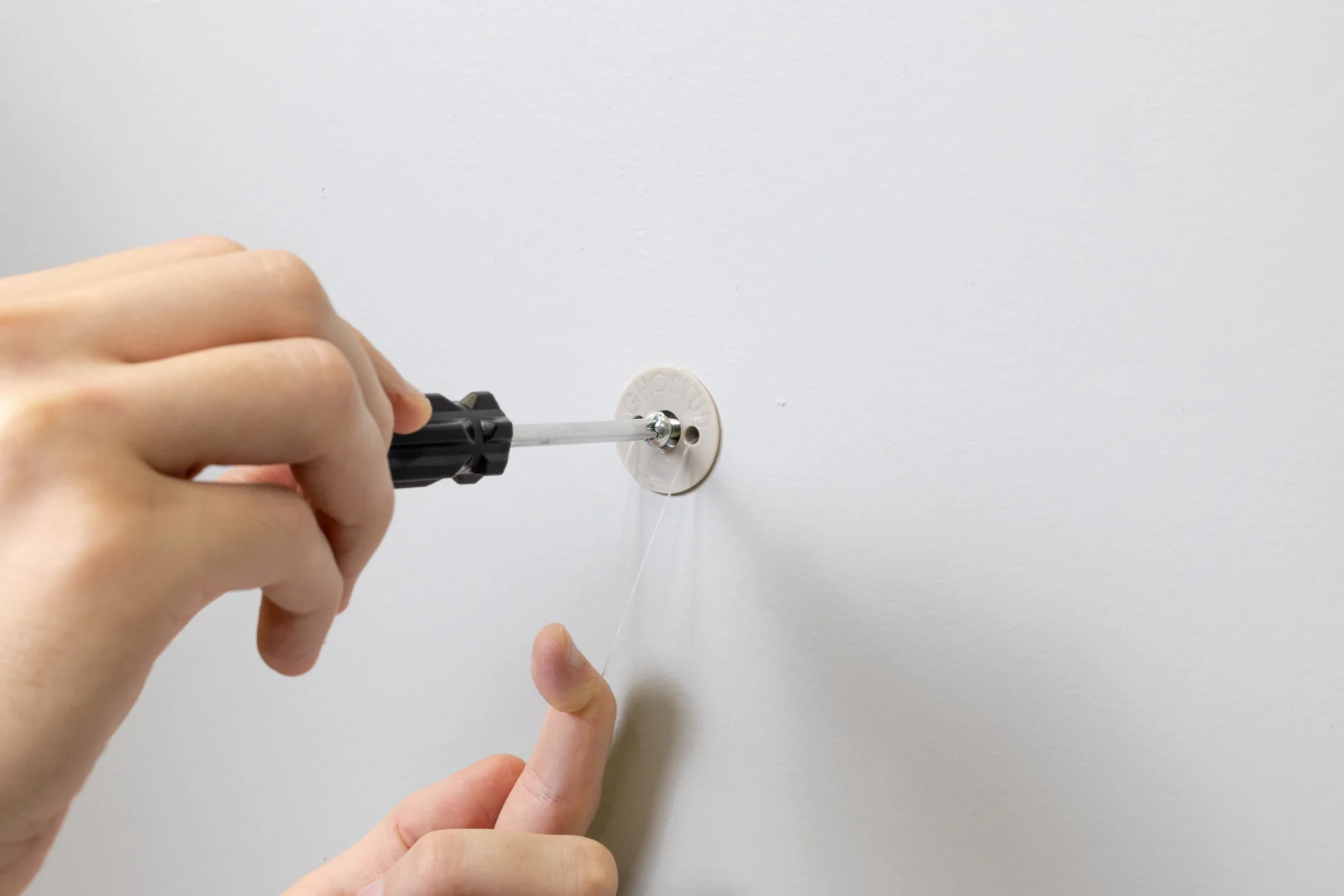
The GS1 requires cutting a 1-inch hole with a hole saw and is rated up to 250 lb in 1/2-inch or 5/8-inch drywall. It uses a patented load-distributing plate that spreads dynamic, rotational clamping force across the rear drywall face. Manufactured in the USA from 100% recycled plastic, the GS1 remains locked in the wall even if you remove the mounting bracket to paint or swap drapery hardware.
Trade-offs: The GS1 requires a 1-inch hole saw for installation, costs more per anchor than commodity zinc plugs, and creates a permanent anchor point intended for long-term installations.
Edge Cases: Stud Mounting, Repairing Wall Blowouts, and Wall Limitations
When NOT to Use Drywall Anchors:
- Studs are present: A 2.5-inch wood screw driven directly into a wood 2×4 stud provides 200+ pounds of holding capacity without any anchor. If a stud falls within your bracket alignment, always drive directly into the wood.
- Non-drywall wall types: GS1 and standard hollow-wall anchors are engineered exclusively for 1/2-inch and 5/8-inch drywall. Do not use them on plaster, lath, brick, masonry, concrete, stucco, tile over backer board, or metal framing studs. These materials require dedicated masonry screws, sleeve anchors, or structural wood blocking.
- Grab bars and safety devices: Never use drywall anchors for grab bars, handrails, or fall-prevention devices where human body weight is supported.
Fixing Damaged Drywall Holes: If an old plastic plug has torn free and left a ragged blowout, you cannot reinstall another expansion anchor in that same spot. Either shift your bracket 1 to 2 inches onto undamaged drywall, or bridge the damaged blowout using a mechanical toggle wing or load-distributing plate that spans well beyond the edges of the damaged hole.
Review our guide to choosing the right drywall anchor for a full breakdown of anchor types and wall conditions, plus our technical guides on how to install curtain rods with anchors and how to fix a sagging curtain rod at home for detailed wall patching protocols.
Frequently Asked Questions About Curtain Rod Anchors
Can I hang a heavy curtain rod without hitting a wall stud?
Yes. You can hang heavy curtain rods without hitting studs by using mechanical anchors that clamp behind the wall cavity, such as toggle bolts or the GS1 load-distributing anchor (rated up to 250 lb in 1/2-inch or 5/8-inch drywall). Avoid basic plastic expansion plugs for heavy drapery.
How many brackets and anchors do I need for a wide window?
Follow these sizing rules:
- Rods up to 36 inches: 2 brackets (one at each end).
- Rods 36 to 72 inches: 3 brackets (both ends plus one center support).
- Rods over 72 inches: 1 bracket every 24 to 36 inches along the entire length to eliminate middle sag.
What should I do if my curtain rod has already pulled out of the drywall?
Remove the fallen bracket and loose gypsum debris. If you cannot relocate the bracket, use a wide toggle anchor whose rear clamping wings span beyond the damaged perimeter, or install a GS1 anchor over the blowout. Secure the bracket, confirm level alignment, and tighten the hardware by hand.
Conclusion
Stop using the cheap plastic conical plugs included in curtain rod packaging. Match your hardware to your actual load: use self-drilling anchors for light sheer panels, toggle bolts for standard single drapes, and the GS1 anchor for heavy blackout curtains and double rods mounted in hollow drywall.
Measure your window width, locate your wall studs, and choose anchors rated for dynamic motion. Explore our complete guide on curtain rod anchors to equip your home with permanent, load-tested mounting hardware.