

The Best Anchors for Hanging a TV Start With the Wall
Use a stud if one is properly located. If no stud lines up, the best anchors for hanging a TV are heavy-duty anchors designed to spread the load behind sound drywall. For a fixed mount on 1/2 in or 5/8 in drywall, a high-capacity load-distributed anchor rated up to 1,000 lb in shear is made for heavy static loads. It requires a 2-inch hole. That shear rating is not a pull-out rating, so do not use it alone to judge a full-motion mount.
Heavy-duty drywall anchors are for drywall only, not plaster, lath, concrete, masonry, brick, stucco, tile over backer board, or metal studs. Choose a solution made for those surfaces instead.
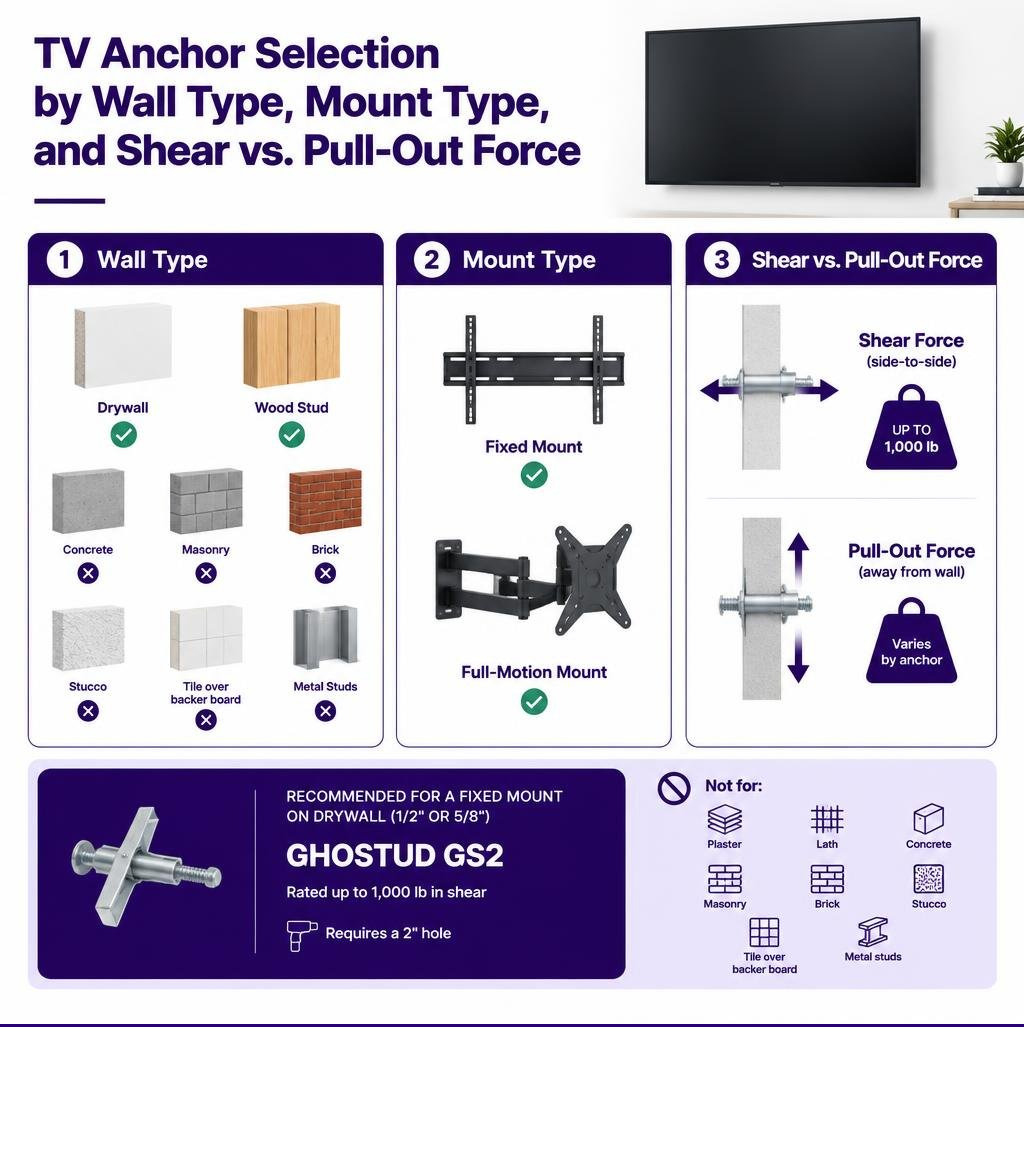
Common best anchors for hanging tv vocab:
- Toggle Bolt Anchor for TV Mount
- Hanging a TV on Drywall Without Studs
- How to Hang TV on Wall Without Studs
Why TV Mounts Fail: Understanding Shear, Tension, and the Lever Effect
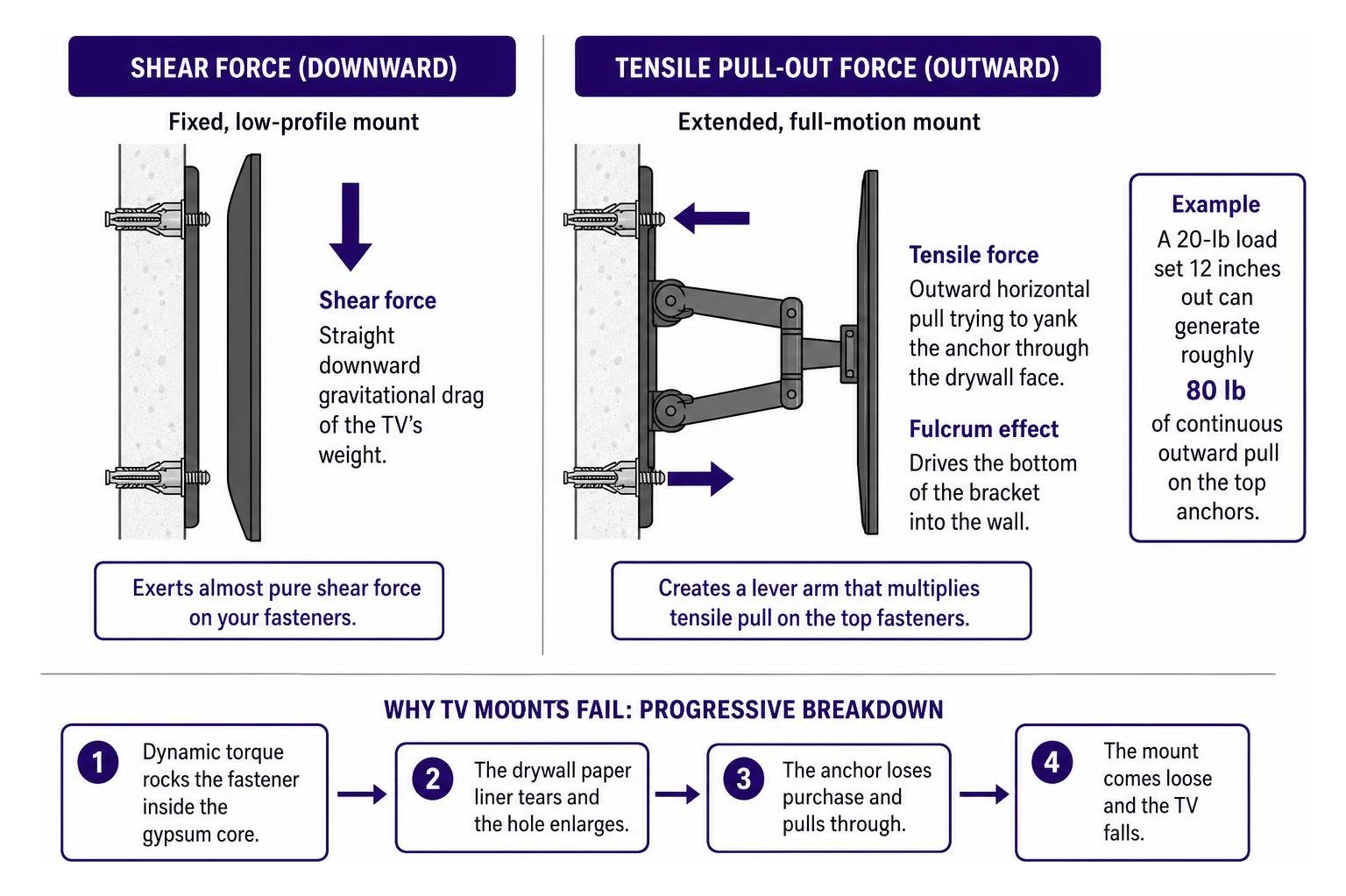
Drywall is compressed gypsum chalk wrapped in paper lining. It has decent vertical compression strength, but poor resistance to concentrated pulling forces. When you hang a television, the bracket places two distinct forces on the wall fasteners: shear force and tensile pull-out force.
Shear force is the straight downward gravitational drag of the TV’s weight. Tensile force is the outward horizontal pull trying to yank the anchor through the drywall face. A low-profile, fixed-position bracket exerts almost pure shear force on your fasteners. In contrast, an extended bracket introduces cantilever physics.
When an arm extends out from the wall, it creates a lever arm. That leverage multiplies the tensile pull on the top fasteners while driving the bottom of the bracket into the wall as a fulcrum. For instance, a floating assembly holding a 20-pound load set 12 inches out can easily generate roughly 80 pounds of continuous outward pull on the top anchors.
Review our guide to understanding shear ratings and wall capacity to see how directional loads dictate fastener limits. Wall thickness also dictates your safety margins. As detailed in the Drywall Anchor Weight Limit: Capacity by Anchor Type reference data, standard residential 1/2-inch drywall loses 20% to 35% of fastener load capacity compared to heavier 5/8-inch commercial drywall boards.
When anchors fail, they suffer a progressive structural breakdown:
- Dynamic torque rocks the fastener inside the gypsum core.
- The fastener head or backing plate pulverizes the chalky gypsum core into loose powder.
- The front or rear paper liner shears.
- The fastener pulls clean through, leaving an oversized blowout crater in the wall.
How to Install Drywall Anchors for a TV Wall Mount Step-by-Step
Follow these steps to hang a TV mount on hollow drywall:
- Scan for framing and obstacles. Run an electronic stud finder across the entire mounting zone. Mark all wood framing. Use a non-contact voltage detector to ensure no live electrical lines run behind the mounting path.
- Position and level the wall plate. Hold the TV wall plate against the wall at your target viewing height. Place a bubble level across the top edge. Mark your target mounting holes through the bracket slots using a pencil. Use a minimum of four anchor points spaced across the outer corners of the bracket.
- Drill the required access holes. Chuck the proper bit into your drill. For standard strap toggles, drill a clean 1/2-inch hole. For GHOSTUD GS2 anchors, cut your holes using a 2-inch hole saw on your pencil marks. Clean away any loose gypsum dust from the edges.
- Insert and seat the anchor bodies. Push the anchor mechanism through the drilled opening. Pull the strap assembly tight to lock the structural backing plate flat against the rear drywall paper. Slide the front retaining ring flush against the outer wall and snap off the excess plastic installation legs.
- Fasten the wall plate. Position the bracket over the anchor receptacles. Thread the machine bolts through flat steel washers, through the bracket slots, and directly into the anchor bodies. Drive the bolts by hand with a screwdriver or a low-torque clutch drill to avoid stripping the gypsum. Snug the plate down firmly against the drywall face without crushing the paper layer.
- Execute a 150-percent pull test. Grab the installed wall plate with two hands. Pull firmly outward and downward with sustained body weight to apply 150% of the display’s static weight for 10 continuous seconds. Check the drywall surrounding the perimeter for cracking, deflection, or movement.
- Hang and lock the television. Bolt the VESA bracket arms to the rear mounting pattern of your TV. Lift the display with a helper, hook the bracket arms over the wall plate rails, and tighten the bottom safety locking screws until fully seated.
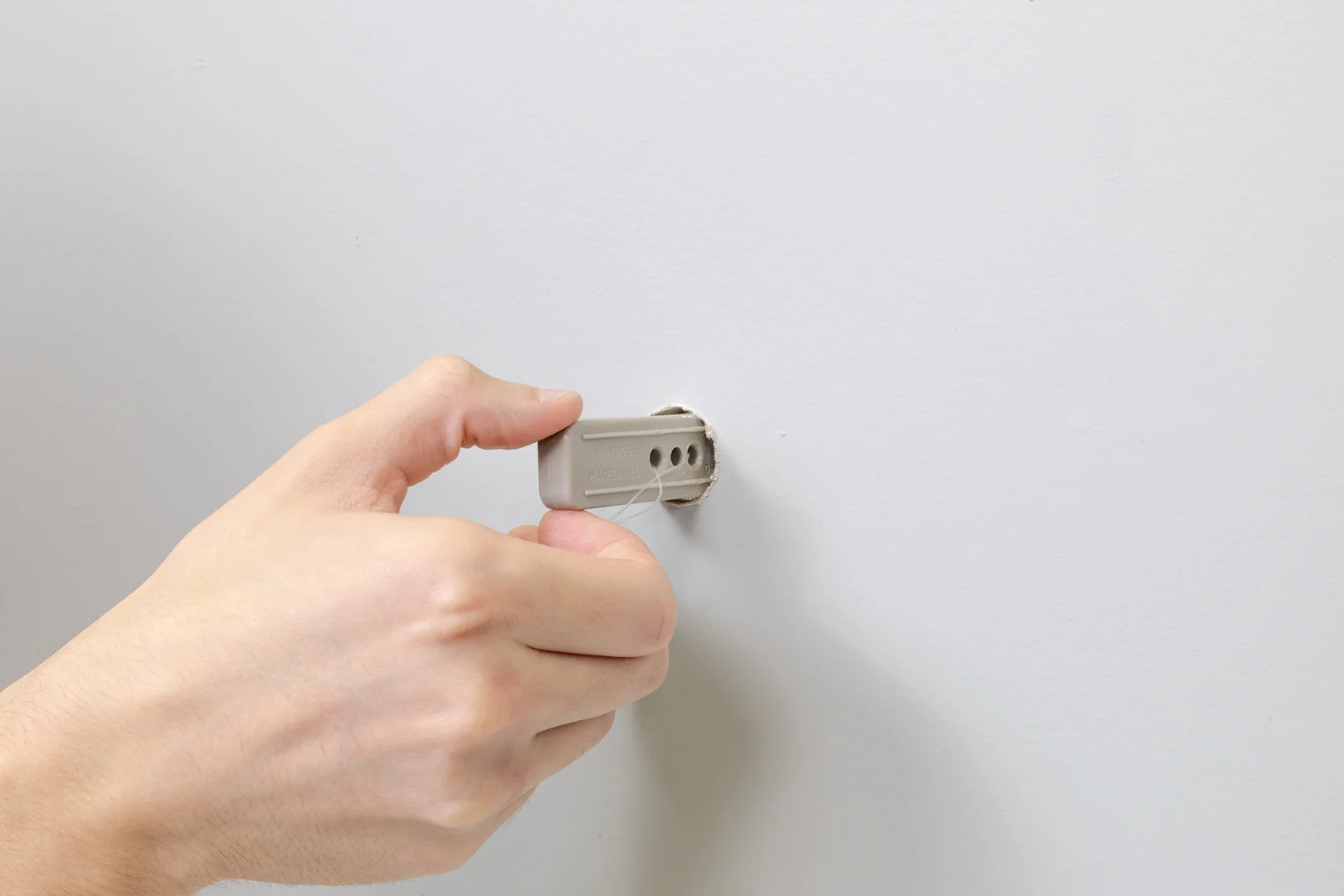
For alternate wall-plate alignment strategies, see our 5-step tutorial on installing a TV wall mount without studs. If you are hanging a screen over 55 inches, follow our dedicated instructions on mounting a large TV on drywall.
The Best Anchors for Hanging TV Mounts Ranked by Holding Power
Never rely on package ratings as absolute working limits. Manufacturers test hardware in pristine conditions, often on thicker 5/8-inch board with static, perpendicular pull. Always maintain a minimum 4x safety factor for overhead and static loads, dividing the ultimate failure rating by four to find your safe working limit.
Before buying hardware, check our ultimate guide to choosing a TV drywall anchor to match your screen’s weight profile to the right fastener class. For broader project comparisons, consult the independent hardware benchmarks at Best Drywall Anchors — From Frames to TV Mounts (2026).
| Anchor Category | Typical 1/2-in Drywall Working Shear Load | Typical 1/2-in Drywall Working Tensile Load | Required Hole Size | Safe for TV Mounting? |
|---|---|---|---|---|
| Plastic Expansion Plug | 5–10 lb | 2–5 lb | 3/16 in to 1/4 in | No. Unsafe for brackets. |
| Self-Drilling Threaded (Zinc) | 20–35 lb | 10–15 lb | Self-drills (#8) | No. Secondary wiring only. |
| Steel Molly Bolt | 25–40 lb | 15–25 lb | 3/8 in | Marginal for small screens (<32 in). |
| Standard Spring Toggle Bolt | 30–55 lb | 20–35 lb | 1/2 in to 5/8 in | Yes, fixed brackets only. |
| Steel Strap Toggle (1/4-20) | 75–110 lb | 40–60 lb | 1/2 in | Yes, fixed/tilting mounts. |
| GHOSTUD GS2 | Up to 1,000 lb shear | High surface-area plate | 2 in | Yes, heavy static TV mounts. |
Light-Duty Hardware: Plastic Expansion and Self-Drilling Anchors
Plastic expansion sleeves rely purely on outward friction against the gypsum core. Standard drywall screws driven straight into gypsum hold only 5 to 10 pounds before stripping out. Plastic plugs increase this hold slightly, but they pull out under minimal outward force. Never use them for TV brackets.
Self-drilling threaded zinc or plastic anchors use wide exterior threads to grip the drywall core. While pairs can hold up to 50 pounds of static downward shear, they have poor pull-out resistance. Reserve self-drilling anchors strictly for secondary wire-management channels, media streaming boxes, or small remote cradles mounted behind the screen.
Toggle Bolts and Snap Toggles: The Best Anchors for Hanging TV Brackets
Traditional spring-wing toggle bolts use a metal wing that folds flat to pass through a drilled hole, springing open inside the hollow wall cavity. As you tighten the machine screw, the wing clamps down against the back face of the drywall. They support substantial loads, but the spring wings drop into the wall cavity if you back the bolt out.
Steel strap toggles improve on this design. A solid metal channel pivots flat along a rigid plastic pull strap. You insert the channel through a 1/2-inch hole, slide the plastic cap tight against the front wall face, and snap off the excess straps. The metal channel remains held permanently in place behind the wall, allowing you to back out the 1/4-20 machine bolt to adjust or level the bracket without losing the fastener.
Read our overview of the safe method for hanging a TV with toggle bolts on drywall to avoid overtightening. If you choose this hardware class, review choosing the correct toggle bolt size for a TV mount to make sure your bracket holes clear 1/4-inch machine bolts.
High-Capacity Load-Distributing Fasteners: The Best Anchors for Hanging TV Displays Safely
Standard toggles concentrate their holding pressure on a narrow metal bar against the back paper liner of the wall. Under repeated vibration or minor adjustments, that narrow footprint can crush the gypsum core.
High-capacity, load-distributing fasteners solve this by expanding the contact perimeter across a much wider surface area of the drywall face. Our GHOSTUD GS2 anchor is engineered for this exact problem on 1/2 in or 5/8 in drywall. It installs via a 2-inch hole saw and provides up to 1,000 lb of shear capacity for heavy static loads like televisions, large mirrors, and shelving.
Review the ultimate guide to best hollow wall anchors for mounting TV to plan wide-plate weight distribution across hollow wall sections.
Mount Selection and Critical Edge Cases: When Anchors Are Not Enough
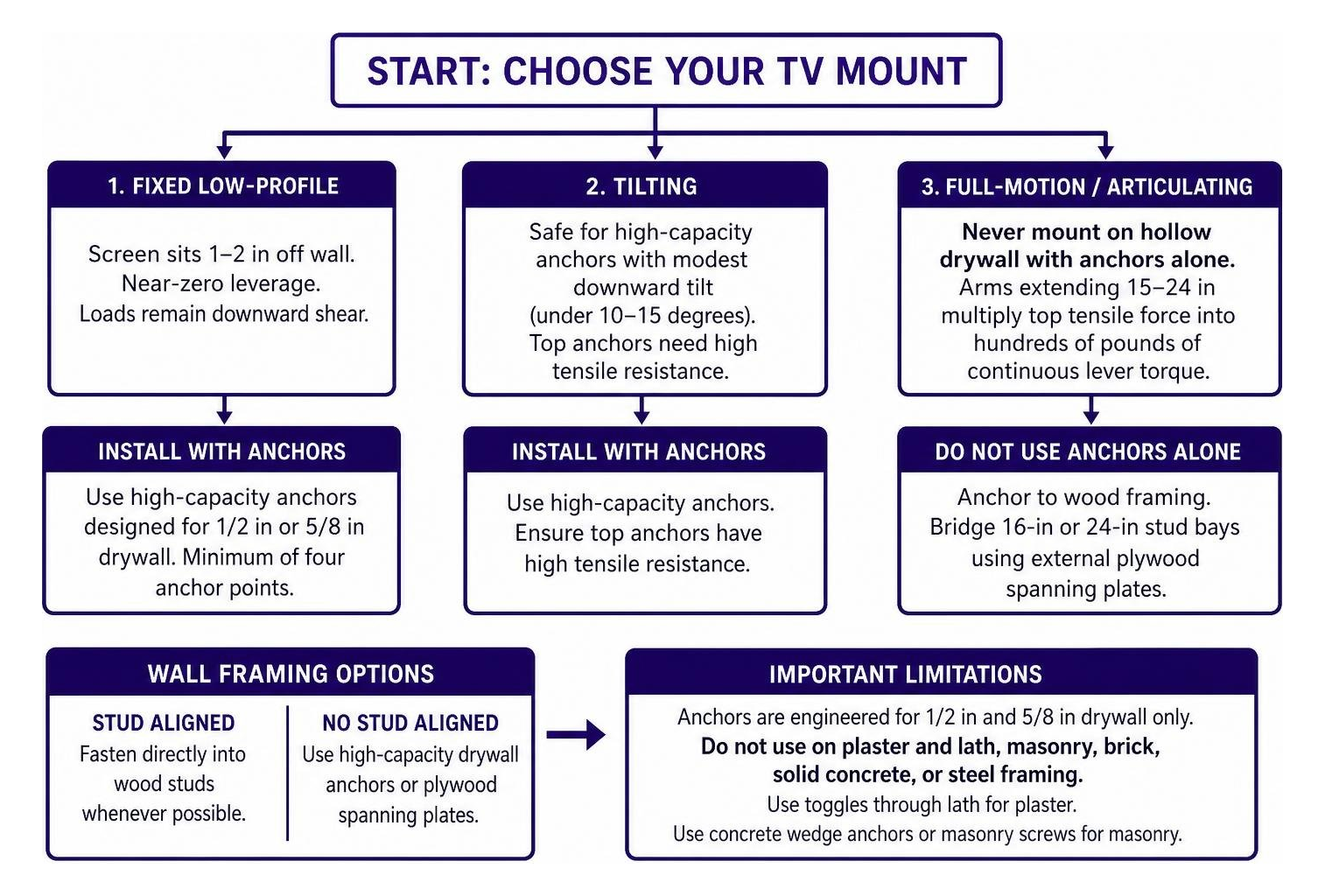
Your choice of bracket determines whether hollow-wall anchors are safe.
- Fixed Low-Profile Mounts: Safe for heavy-duty drywall anchors. The screen sits 1 to 2 inches off the wall, creating near-zero cantilever leverage. Loads remain almost pure downward shear.
- Tilting Mounts: Safe for high-capacity anchors when downward tilt is modest (under 10 to 15 degrees). Ensure top anchors have high tensile resistance.
- Full-Motion / Articulating Mounts: Never mount these on hollow drywall with anchors alone. An arm extending 15 to 24 inches multiplies the outward tensile force on the top fasteners into hundreds of pounds of continuous lever torque whenever the screen moves.
Read the technical breakdown in Stud Mount vs Toggle Anchor (2026) to compare dynamic force tolerances. When studs don’t center on your wall, see the homeowners guide to hanging a TV without a stud for details on bridging 16-inch or 24-inch stud bays using external plywood spanning plates.
Explicit Non-Drywall Limitations
Anchors like GHOSTUD are engineered solely for 1/2 in and 5/8 in drywall. Do not use them on plaster and lath, masonry, brick, solid concrete, or steel framing. For plaster, use toggle bolts through lath strips or anchor to framing. For masonry, use concrete wedge anchors or masonry screws driven into sound brick or block.
Frequently Asked Questions About TV Drywall Anchors
Is it safe to mount a 65-inch or 75-inch TV on drywall without hitting a stud?
Yes, but only with a fixed or low-profile tilting mount and a minimum of four heavy-duty, high-capacity anchors. The bracket must span a wide surface area to distribute the weight across multiple drywall points. If your screen requires an articulating arm that pulls away from the wall, you must anchor directly into structural wood studs.
Can you reuse the holes if you take down or reposition the TV mount?
With traditional spring-wing toggle bolts, no. Backing out the machine screw drops the wings down inside the wall cavity, leaving an open hole. With steel strap toggles and GHOSTUD anchors, the backing collar stays seated in the wall, letting you unbolt and remount hardware. If you relocate the TV entirely, patch the hole by beveling the edges, installing a backing patch, and applying drywall compound.
What is the difference between shear and tensile pull-out strength for TV anchors?
Shear strength measures resistance to vertical, downward loads pulling parallel to the wall face. Tensile strength measures resistance to outward horizontal forces pulling perpendicular to the wall face. Fixed mounts load anchors primarily in shear, while articulating arms and deep shelves introduce severe tensile loads that can rip small anchors straight out of the drywall.
Safe Mounting Summary and Best Practices
Hanging a TV safely without studs comes down to mechanical fundamentals:
- Always fasten directly into wood studs with lag screws whenever framing is accessible.
- Use fixed or low-profile brackets when mounting directly to hollow drywall.
- Distribute the screen’s load across a minimum of four heavy-duty anchors.
- Confirm your wall is sound 1/2-inch or 5/8-inch drywall, not plaster, masonry, or tile.
- Perform a 150-percent physical pull test on the bracket before hanging the television.
For static TV loads on hollow drywall, the GHOSTUD GS2 anchor provides up to 1,000 lb of shear capacity in 1/2 in or 5/8 in drywall using a standard 2-inch hole saw. For smaller utility fixtures like bathroom hardware or curtain brackets, our smaller GS1 installs with a 1-inch hole saw and supports up to 250 lb. For step-by-step structural workflows, review our complete guide to mounting a TV without studs.
Now, take your tape measure, locate your wall studs, and verify your display’s bracket geometry before drilling your first hole.